✍️ Authored by the ACSPR Team | Climate, People & Planet
📌 Shaping Africa’s Future with Evidence, Equity, and Innovation for Impact
Climate Change: More Than an Environmental Problem
📌 Shaping Africa’s Future with Evidence, Equity, and Innovation for Impact
Climate Change: More Than an Environmental Problem
Climate change is often discussed in technical terms carbon emissions, temperature thresholds, and mitigation targets. Yet for millions of people across Africa, climate change is already a human crisis, shaping daily realities of hunger, illness, displacement, and lost opportunity.
According to the World Health Organization, climate change is one of the greatest threats to global health in the 21st century, undermining the fundamental determinants of well-being: food security, clean water, safe shelter, and livelihoods. These impacts fall most heavily on populations that have contributed the least to global greenhouse gas emissions.
This blog argues that climate action in Africa must move beyond emissions and infrastructure to focus squarely on people, dignity, and equity because climate change is not just an environmental challenge, but a profound human development crisis.
The Human Cost of Climate Change
Health at Risk
The WHO estimates that between 2030 and 2050, climate change will cause approximately 250,000 additional deaths per year from malnutrition, malaria, diarrhoeal diseases, and heat stress alone. These impacts will disproportionately affect low-income countries with fragile health systems and limited adaptive capacity.
Food, Nutrition, and Poverty
The Intergovernmental Panel on Climate Change confirms that climate variability and extreme weather events have already reduced agricultural productivity across Africa, particularly in rain-fed systems.
The World Bank estimates that climate change could push up to 132 million people globally into extreme poverty by 2030, primarily through its effects on agriculture, food prices, and livelihoods impacts that are most severe in Sub-Saharan Africa.
Africa: Least Responsible, Most Exposed
Africa contributes less than 4% of global greenhouse gas emissions yet bears a disproportionate share of climate-related losses and damages (UNEP). Climate change therefore acts as a multiplier of existing inequalities, deepening poverty, gender disparities, and regional marginalization.
Uganda: When Climate Shocks Become Human Crises
Uganda illustrates how climate change translates directly into human development setbacks.
The country’s heavy reliance on rain-fed agriculture makes rural livelihoods acutely vulnerable to climate variability. According to the World Bank, climate shocks in Uganda are associated with declining agricultural productivity, rising food insecurity, and increased vulnerability among poor households.
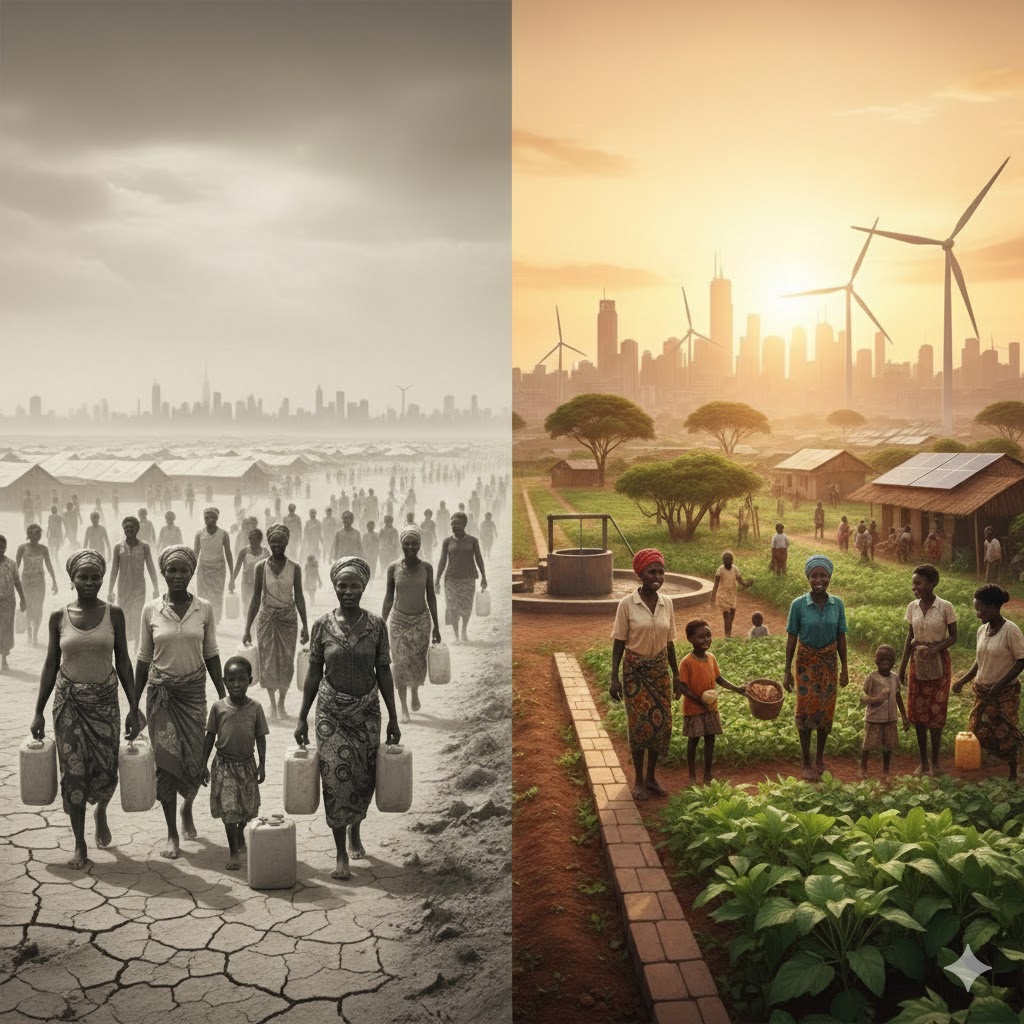
In Uganda’s Karamoja region, consecutive droughts have done more than collapse harvests. They have contributed to measurable increases in school dropout rates, as children especially girls are forced to travel longer distances in search of water or engage in family labour to cope with food shortages. What begins as a climate shock quickly cascades into a nutrition, education, and gender equity crisis.
This is the human face of climate change: not abstract future risks, but present disruptions to health, learning, and dignity.
Why Climate Action Must Be People-Centered
1. Vulnerability Is Socially Determined
Climate impacts are not evenly distributed. Poverty, gender, age, disability, and geographic isolation shape exposure and capacity to adapt. The WHO emphasizes that social determinants of health strongly influence vulnerability to climate-related risks, meaning climate change exacerbates existing inequities.
2. Adaptation Is About Lives, Not Just Infrastructure
While infrastructure and emissions reductions are critical, people-centered adaptation focuses on:
- ● Protecting livelihoods
- ● Strengthening health and social protection systems
- ● Supporting community-led resilience strategies
Evidence shows that locally grounded, community-led adaptation delivers more sustainable and equitable outcomes than top-down approaches alone.
3. Health Is a Strategic Entry Point
Climate change threatens decades of public health gains. Heat stress, undernutrition, vector-borne diseases, and mental health impacts are rising. The WHO calls for climate-resilient health systems that can anticipate, absorb, and respond to climate shocks—especially for vulnerable populations.
Putting People at the Center of Climate Action
Effective climate action in Africa must prioritize:
✔ Equity and Inclusion – Explicitly addressing who benefits and who bears the costs
✔ Climate-Resilient Health Systems – Integrating climate risks into health planning and early warning systems
✔ Livelihood-Focused Adaptation – Supporting climate-smart agriculture, diversified incomes, and social protection
✔ Community-Led Solutions – Valuing local knowledge and participation
✔ Evidence-Based Policy – Using disaggregated data to target the most vulnerable
✔ Climate-Resilient Health Systems – Integrating climate risks into health planning and early warning systems
✔ Livelihood-Focused Adaptation – Supporting climate-smart agriculture, diversified incomes, and social protection
✔ Community-Led Solutions – Valuing local knowledge and participation
✔ Evidence-Based Policy – Using disaggregated data to target the most vulnerable
A Sharpened Call to Action
For Donors
Shift adaptation finance beyond standalone infrastructure projects toward integrated programmes that combine water security, climate-smart agriculture, nutrition, and community health where human vulnerability is addressed holistically.
For African Policymakers
Mainstream climate vulnerability indices into national social protection and social registry systems, enabling governments to proactively target at-risk households before shocks occur, rather than responding after losses have already accumulated.
For Development Partners and Researchers
Invest in local research capacity and climate-health data systems that generate context-specific evidence to guide people-centered adaptation strategies.
Conclusion: Evidence for People, Not Just the Planet
Climate change is not only about degrees of warming or tonnes of emissions, it is about people’s lives, dignity, and futures. For Africa, climate action must be a fight for human well-being and equity, not just environmental targets.
The success of climate action will be measured in lives protected and inequalities reduced. Achieving this requires evidence that illuminates human vulnerability not just atmospheric change. When climate policy is grounded in data, equity, and lived realities, it becomes a powerful tool not only for protecting the planet, but for advancing human dignity.