✍️ Authored by the ACSPR Team | Humanitarian Response & Resilience
📌 Shaping Africa’s Future with Evidence, Equity, and Innovation for Impact
📌 Shaping Africa’s Future with Evidence, Equity, and Innovation for Impact
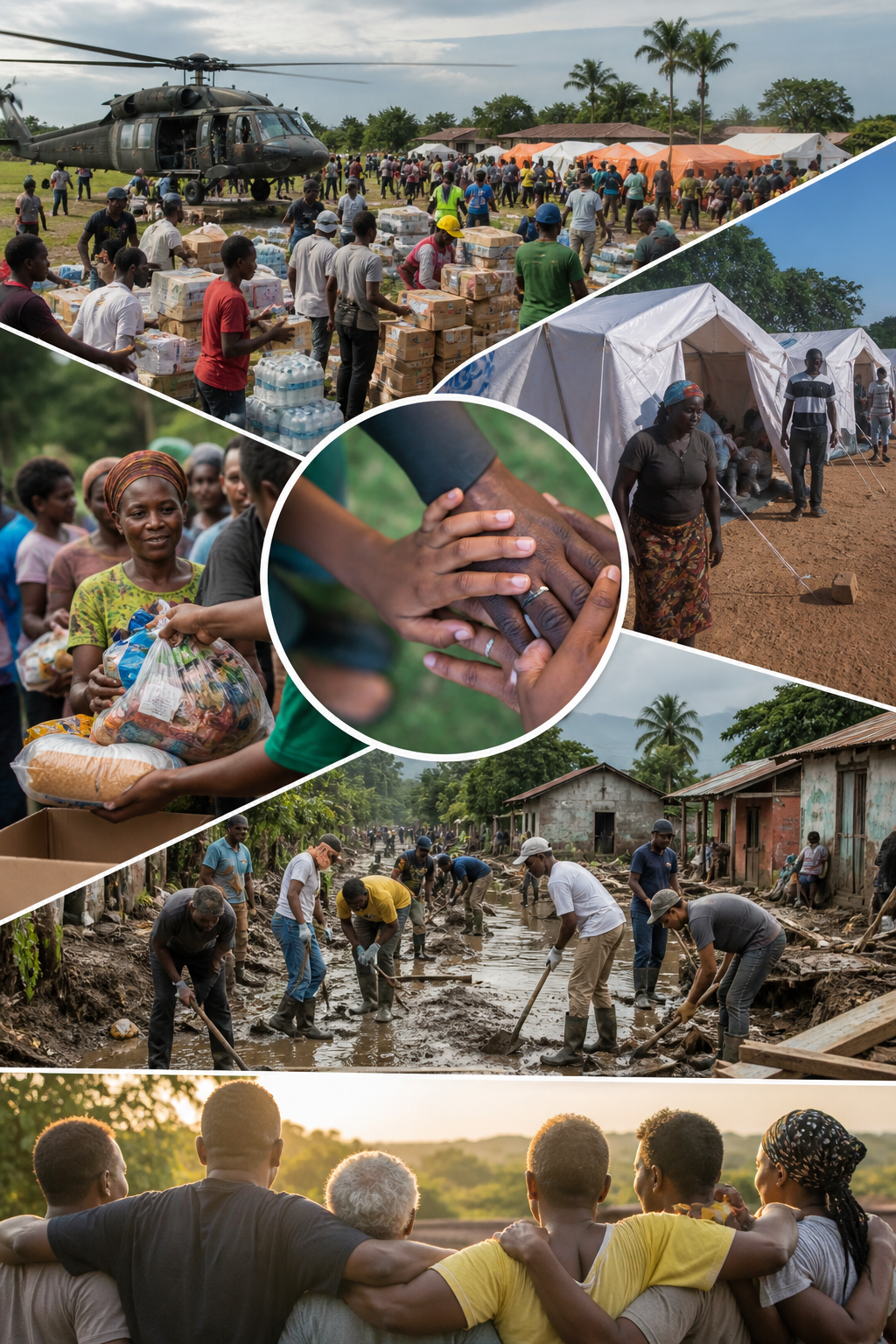
After a disaster, the world responds quickly. Food arrives. Tents are erected. Roads are cleared. Aid flows in.
Yet months later, a familiar pattern emerges:
Some communities begin to rebuild their lives. Others remain stuck dependent, fragmented, and vulnerable.
Some communities begin to rebuild their lives. Others remain stuck dependent, fragmented, and vulnerable.
The difference is rarely explained by funding alone. It is shaped by something less visible but far more powerful: social systems.
Across disasters from earthquakes in Nepal to hurricanes in Puerto Rico, and floods across Africa research consistently shows that recovery is not just a technical process. It is a social one. It depends on how people trust each other, organize collectively, access networks, and engage with institutions.
Why Relief Alone Is Not Enough
Humanitarian systems are designed for urgency. They are built to save lives in the immediate aftermath of crisis. And they do this well.
But recovery is not an event it is a process. One that unfolds over months, years, and sometimes decades.
What often goes missing in this transition from response to recovery is an understanding that:
Rebuilding communities is not just about restoring infrastructure - it is about restoring relationships.
A road can be rebuilt in weeks. Trust, coordination, and collective capacity take much longer. Without them, even well-funded recovery efforts struggle to gain traction.
The Invisible Infrastructure: Social Capital
Social researchers often describe social capital as the “hidden engine” of recovery. It refers to the networks, trust, and relationships that connect individuals and communities.
But this is not an abstract concept, it is deeply practical.
● It is the neighbor who checks on elderly households after a flood.
● It is the local leader who organizes volunteers to clear debris.
● It is the informal group that ensures aid reaches those who are often overlooked.
Social capital operates through different layers:
● Bonding ties, such as family and close friends, provide immediate support and care
● Bridging ties connect different groups, enabling cooperation and shared resources
● Linking ties connect communities to institutions, unlocking access to formal support systems
In communities where these ties are strong, recovery tends to be faster and more coordinated. Where they are weak, even well-designed interventions can falter.
What Real Recovery Looks Like in Practice
The role of social systems becomes clearer when we look at real-world experiences.
After Typhoon Haiyan in the Philippines, some communities were able to rebuild far more quickly than others not because they received more aid, but because they had strong pre-existing local networks. These networks allowed them to coordinate distribution, identify the most vulnerable, and organize reconstruction efforts without waiting for external direction.
Closer to home, in Uganda’s Bududa district, where landslides are a recurring threat, survival often depends on trust. Community-based early warning systems work not simply because information is shared, but because it is believed. When warnings come from trusted neighbours, people act. When they do not, evacuation delays can be fatal.
In these contexts, recovery is not delivered, it is mobilized.
From Individuals to Communities: The Power of Shared Experience
Disasters do more than destroy, they also reshape social dynamics.
People who go through crises together often develop a strong sense of shared identity. They begin to see themselves not just as individuals affected by disaster, but as part of a collective.
This shift matters.
It encourages:
● Cooperation instead of competition
● Mutual aid instead of isolation
● Collective problem-solving instead of dependence
These “disaster communities” often become the backbone of recovery providing emotional support, organizing local action, and sustaining momentum long after external actors have left.
How Networks Shape Who Recovers and Who Doesn’t
Recovery is not evenly distributed. It flows through networks.
Those who are well-connected tend to:
● Receive information earlier
● Access aid more quickly
● Mobilize support more effectively
Others especially those who are socially isolated, marginalized, or geographically remote may struggle to access even basic assistance.
Social research has introduced the idea of “recovery multipliers” individuals or groups whose networks extend support across entire communities. These actors amplify the reach of recovery efforts.
But the absence of such networks can have the opposite effect, reinforcing exclusion and deepening inequality.
Digital Connections: A New Layer of Resilience
In recent years, social networks have expanded into the digital space.
Mobile phones, WhatsApp groups, and social media platforms now play a central role in crisis response. They are used to:
● Share real-time updates during emergencies
● Coordinate relief distribution
● Identify urgent needs
● Hold authorities accountable
In many contexts, these digital connections have become critical lifelines, especially where formal communication systems are weak or slow.
However, they also introduce new risks particularly for those who lack access to technology or digital skills, reinforcing existing inequalities.
When Recovery Ignores Social Realities
Despite growing evidence, many recovery efforts still prioritize physical reconstruction over social systems.
The consequences are predictable.
Programs that overlook local dynamics often:
● Miss the most vulnerable populations
● Duplicate efforts or misallocate resources
● Undermine existing community structures
Social research highlights how factors such as gender, poverty, social status, and remoteness shape access to recovery support. Without deliberate attention to these factors, recovery can unintentionally deepen inequality.
What Social Research Changes
Social research shifts the way we think about recovery.
It challenges the assumption that solutions should be centrally designed and externally delivered. Instead, it emphasizes that sustainable recovery emerges when communities are actively involved in shaping their own futures.
It also expands what we measure. Success is no longer defined only by infrastructure rebuilt or funds disbursed, but by:
● Strengthened community networks
● Increased trust and cooperation
● Improved wellbeing and resilience
What This Means in Practice
To move beyond relief, recovery efforts must be reimagined.
● Humanitarian agencies need to understand social networks as deeply as they understand physical needs
● Donors must invest not only in infrastructure, but in the social systems that sustain recovery
● Governments should strengthen local institutions and trust before crises occur not after
● Researchers must continue to generate evidence on how relationships, networks, and identity shape recovery outcomes
Crisis recovery is often framed as a technical challenge. But at its core, it is a human one.
It is about how people come together, support one another, and rebuild not just what was lost but what holds them together.
Moving beyond relief means recognizing that resilience is not built in structures alone, it is built in relationships.
ACSPR Perspective
At the African Centre for Social and Population Research (ACSPR), we believe that effective recovery must be grounded in a deep understanding of social realities.
By generating evidence on how communities organize, trust, and respond to crisis, we aim to inform policies that do more than rebuild they strengthen the foundations of resilience across Africa.