
✍️ Authored by the ACSPR Team | Climate, People & Planet
📌 Shaping Africa’s Future with Evidence, Equity, and Innovation for Impact
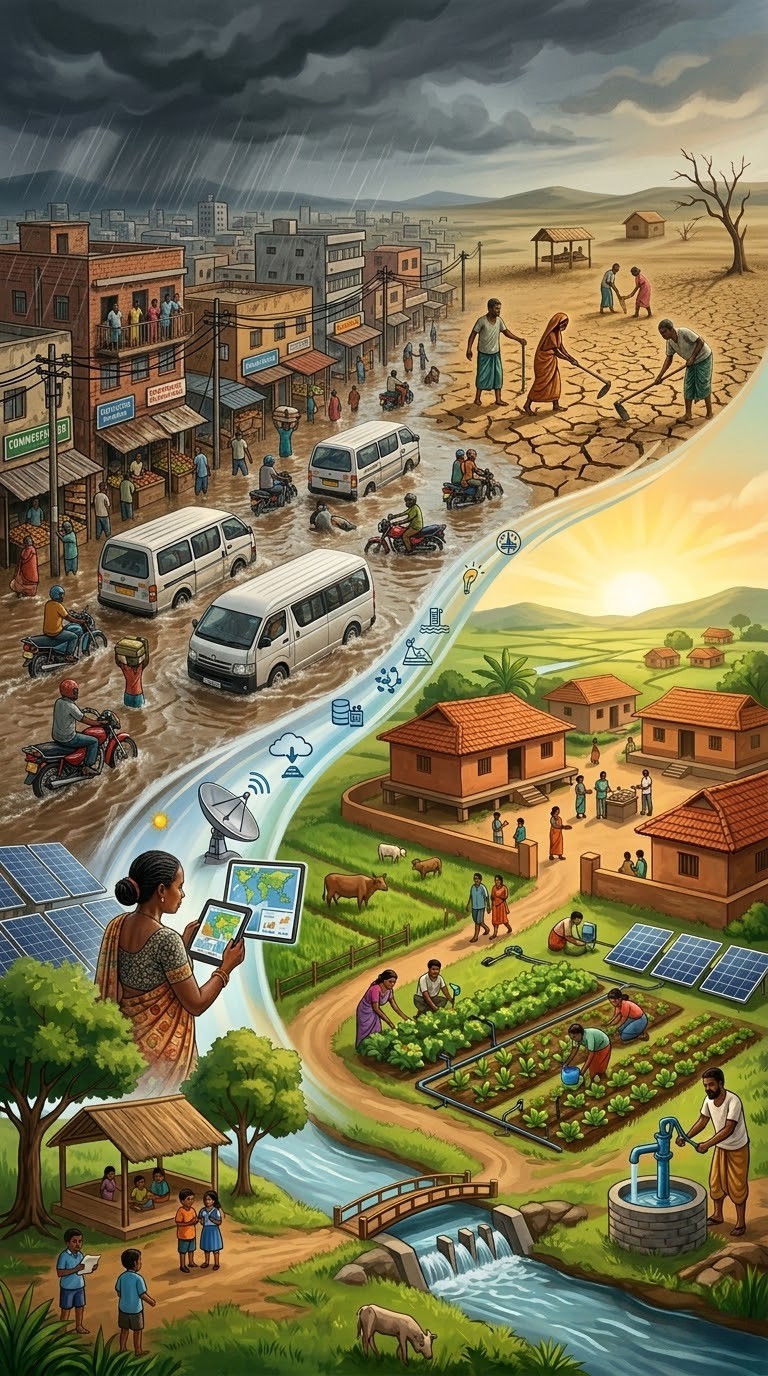
Across the world, communities are increasingly confronting climate shocks floods that destroy homes, droughts that threaten food security, and rising temperatures that strain already fragile health and infrastructure systems. For many vulnerable regions, climate change has turned daily life into a constant struggle for survival.
📌 Shaping Africa’s Future with Evidence, Equity, and Innovation for Impact
Across the world, communities are increasingly confronting climate shocks floods that destroy homes, droughts that threaten food security, and rising temperatures that strain already fragile health and infrastructure systems. For many vulnerable regions, climate change has turned daily life into a constant struggle for survival.
Yet survival is not the same as resilience.
Resilient communities do more than react to disasters. They anticipate risks, adapt to environmental change, and transform systems to withstand future shocks. Evidence from climate research increasingly shows that the most successful climate-smart communities combine strong social networks, nature-based solutions, smart technologies, and inclusive governance.
In other words, resilience is not built by infrastructure alone - it is built by people, knowledge, and collective action.
Why Community Resilience Matters in the Climate Era
Climate change is intensifying existing vulnerabilities across many parts of Africa and the Global South. Rural farmers face unpredictable rainfall patterns and crop failures. Urban communities confront flooding, heat waves, and inadequate infrastructure. Health systems struggle to manage climate-related disease risks.
In this context, community resilience becomes a central development priority. It determines whether communities can absorb shocks, recover quickly, and continue improving livelihoods despite environmental stress.
Evidence suggests that resilience is strongest when climate strategies address not only physical infrastructure, but also social relationships, governance systems, and local knowledge.
The Pillars of Climate-Smart Community Resilience
Strong Social Capital and Community Cohesion
Trust, reciprocity, and shared networks - the core elements of social capital, play a central role in disaster preparedness and recovery. Communities with strong social ties share information faster, pool resources during crises, and support vulnerable members when formal systems are overwhelmed.
Trust enables rapid communication and coordination. Reciprocity creates informal safety nets when households lose income, crops, or shelter. A shared community identity strengthens the willingness of people to act collectively during crises.
However, resilience strategies must ensure these networks are inclusive. When social capital is limited to tightly bonded groups, marginalized populations such as migrants, informal settlers, women, or youth may be excluded from access to resources and decision-making.
Integrated Strategies Across Systems
Climate resilience cannot be achieved through isolated interventions. Infrastructure improvements alone - such as flood barriers or irrigation systems rarely address the full complexity of climate risk.
Evidence shows that resilience strategies work best when they combine social, environmental, and institutional approaches. Community engagement, ecosystem protection, governance reform, and livelihood diversification together create more durable responses to climate stress.
When these elements work together, communities are better able to anticipate shocks rather than simply react to them.
Local and Indigenous Knowledge
Long before climate science became a global policy concern, communities developed traditional practices to manage environmental variability. Indigenous and local knowledge systems contain valuable insights about ecosystems, seasonal patterns, water management, and sustainable land use.
When this knowledge is combined with scientific research and modern technologies, solutions become more locally relevant and culturally grounded.
Resilience is strongest when communities are not passive recipients of interventions but active partners in designing them.
Tools for Building Climate-Smart Communities
Nature-Based Solutions
Nature-based solutions are increasingly recognized as powerful tools for climate adaptation. Restoring wetlands, protecting forests, and expanding urban green spaces can reduce flooding, cool cities, improve air quality, and strengthen biodiversity.
Nature in Action: Kampala’s Slope Greening
In Uganda’s capital Kampala, communities are spearheading slope stabilization by re-greening hilltops with native vegetation. This low-cost intervention slows flood runoff, improves air quality, and provides shade in heat-prone neighbourhoods while residents help monitor and maintain restored landscapes.
Such interventions demonstrate how environmental restoration can strengthen both ecological and community resilience.
Smart Technologies and Early Warning Systems
Digital tools are also transforming climate preparedness. Early warning systems, climate data platforms, and digital mapping technologies allow communities to anticipate extreme weather events and coordinate faster responses.
Emerging technologies including climate modelling and digital replicas of cities can help planners identify vulnerable infrastructure and test adaptation strategies before disasters occur. However, these technologies are effective only when supported by reliable connectivity, local governance capacity, and inclusive data systems.
Climate-Smart Agriculture
In rural regions, climate-smart agriculture is becoming essential for protecting livelihoods and food security. These practices include drought-resistant crops, improved soil management, diversified farming systems, and climate-informed planting strategies.
Evidence from smallholder farming communities shows that adopting climate-smart agricultural practices can significantly strengthen resilience to climate shocks while maintaining productivity.
In Mauritania, for example, innovative “village re-bushing” initiatives combine indigenous land restoration knowledge with drone technology. Seeds are dispersed across degraded landscapes during rainy seasons, regenerating vegetation over large areas and reducing vulnerability to drought.
Community-Led Approaches: What Evidence Shows
One of the clearest findings in resilience research is that community-led approaches consistently outperform externally imposed solutions.
Participatory planning, systems mapping, and collaborative research processes help communities identify risks, prioritize interventions, and build shared responsibility for implementation.
In Kenya’s informal settlements of Mathare and Mukuru, climate adaptation initiatives have shown that success depends on what researchers describe as “legitimized and trusted agency.” When community leadership works in partnership with government institutions and trusted local organizations, adaptation strategies are more sustainable and widely adopted.
Resilience is therefore not a one-time intervention - it is an ongoing process of learning, cooperation, and collective action.
The Risks of Poorly Designed Interventions
Not all climate resilience programs strengthen communities. In some cases, externally designed projects can inadvertently weaken traditional systems of cooperation.
Research from farming communities in Nepal shows that poorly integrated interventions may undermine existing collective practices such as labour sharing, seed exchanges, and mutual aid networks. When programs overlook local institutions and knowledge systems, they risk eroding the very social cohesion that enables resilience.
This underscores a key lesson: community leadership must be central, not peripheral, to resilience planning.
What This Means for Policy and Practice
Building climate-smart communities requires more than technical solutions. It demands integrated strategies that place communities at the centre of adaptation efforts.
For policymakers and practitioners:
✔Invest in social infrastructure trust, networks, and inclusive governance alongside physical infrastructure
✔Support community-led processes rather than externally designed programs
✔Combine nature-based solutions with early warning systems and climate-smart agriculture
✔Ensure marginalized groups, including women, youth, and informal settlement residents, are active participants in decision-making
✔Strengthen partnerships between communities, researchers, and government institutions
Resilience emerges where technical knowledge meets community agency.
From Climate Response to Climate Transformation
Climate change will continue to reshape how communities live, farm, and build cities. But vulnerability is not inevitable.
Evidence shows that communities become resilient when strong social capital, inclusive governance, local knowledge, and innovative solutions come together.
Technical tools alone cannot build resilience. What ultimately determines success is whether communities themselves are empowered to anticipate risks, adapt to change, and shape their own futures.
Moving from survival to resilience is therefore not just a climate challenge - it is a development imperative.