✍️ Authored by the ACSPR Team | Education & Skills Development
📌 Shaping Africa’s Future with Evidence, Equity, and Innovation for Impact
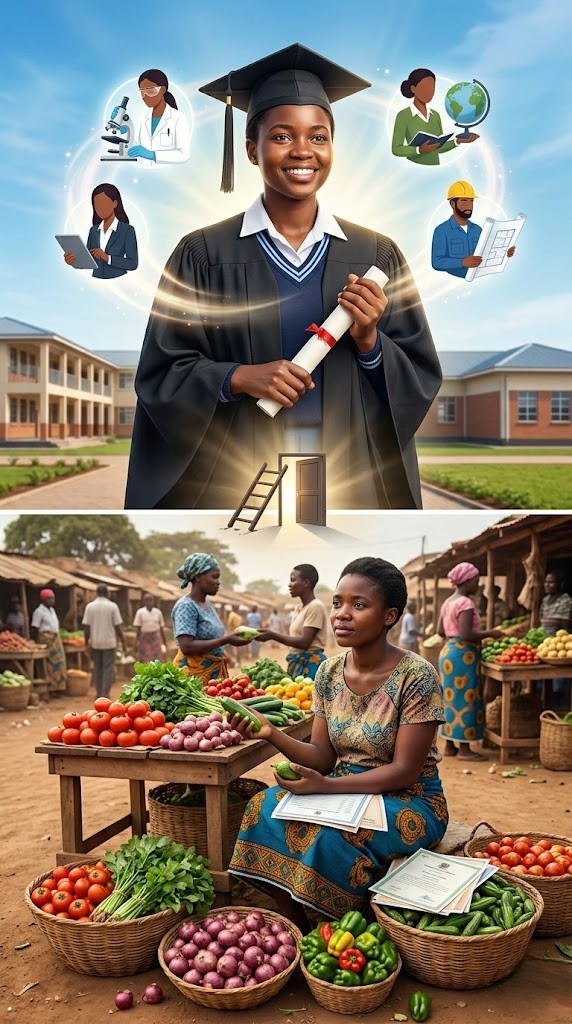
Fatima completed secondary school in rural Malawi with top marks. Two years later, she sells vegetables at the local market not because she lacks ambition or ability, but because the formal economy has no place for her. Her story is not personal failure. It is policy failure.
📌 Shaping Africa’s Future with Evidence, Equity, and Innovation for Impact
Fatima completed secondary school in rural Malawi with top marks. Two years later, she sells vegetables at the local market not because she lacks ambition or ability, but because the formal economy has no place for her. Her story is not personal failure. It is policy failure.
Over the past two decades, expanding girls’ enrolment has been one of the most celebrated development achievements across Africa and other low- and middle-income regions. But enrolment alone does not guarantee empowerment. The harder task is converting years in school into real economic power income, assets, autonomy, and voice in decisions.
Education opens doors. But systems must ensure there is something meaningful on the other side.
What Economic Empowerment Really Means
Economic empowerment is more than employment. It includes the ability to earn and control income, build assets, access financial services, make household decisions, and participate meaningfully in community and economic life. It also includes the freedom to plan one’s future without coercion whether in marriage, childbearing, or work choices.
If girls complete school but still cannot access decent work, safe livelihoods, or financial agency, then education has not delivered its full promise.
How Schooling Can Lead to Economic Empowerment
Evidence and experience point to four major pathways through which girls’ education can become economically transformative.
1) Skills and Productivity
Quality schooling builds the foundational skills that determine economic opportunity: literacy, numeracy, problem-solving, communication, and increasingly, digital competence. When girls learn well, they become more productive workers, stronger entrepreneurs, and more capable of adapting to changing labour markets. Education also strengthens practical knowledge how to manage money, interpret information, and make informed choices skills that matter both inside and outside formal employment.
2) Labor Market Access and Earnings
Schooling helps girls access better jobs by providing credentials, confidence, and networks. Secondary completion is especially important because it often marks the point where opportunities expand from informal survival work to more stable employment pathways, further training, and higher earnings. When education aligns with labour market demand, returns increase for individuals and for the broader economy.
3) Household and Financial Agency
Education strengthens bargaining power. Women with more schooling are often better positioned to participate in household financial decisions, manage savings, seek credit, and navigate formal services. This kind of agency can be life-changing: it reduces economic dependency, strengthens resilience during shocks, and shifts household priorities toward long-term investments such as children’s schooling and health.
4) Intergenerational Transformation
Educated women tend to invest more in their children. This ripple effect matters: when mothers have economic agency, children are more likely to stay in school and progress through grades. Education also contributes to delayed early marriage and childbearing improving long-term earning potential, health, and social mobility.
Girls’ education, done well, does not just transform one life. It transforms a family’s trajectory.
Why Access Alone Is Not Enough
Many countries have expanded school access, yet the transition from schooling to empowerment remains weak. This is because education systems often deliver years of attendance without delivering strong learning, practical skills, or safe environments.
Four factors repeatedly determine whether education becomes empowering:
Quality and Relevance
Schooling must produce real learning and relevant skills. Curricula that include life skills, financial literacy, digital literacy, and vocational pathways help girls translate schooling into work and agency. Teaching methods also matter classrooms that reinforce harmful gender norms weaken empowerment, while gender-responsive pedagogy strengthens confidence and aspirations.
Completion of Secondary School
Secondary completion is a turning point. Girls who drop out early lose future earnings, face higher risks of early marriage and pregnancy, and are less likely to access decent work. Keeping girls in school through secondary is one of the most direct ways to increase economic returns.
Safe and Supportive School Environments
Safety is not a “nice-to-have.” It is fundamental. Gender-based violence, harassment, long unsafe journeys to school, and stigma around menstruation all reduce retention and learning. So do hidden costs like uniforms, transport, exam fees, and basic supplies. Girls stay in school and learn when systems actively reduce these barriers.
Norm and Governance Change
Education cannot be separated from society. Restrictive norms around gender roles, mobility, and “appropriate” work shape whether educated girls can pursue opportunities. Governance matters too: education budgets and reforms must prioritize learning quality, retention, and transition pathways not just enrolment numbers.
When norms and systems do not change, education may raise aspirations without creating opportunity. That gap can be damaging.
What Works: Interventions That Shift Outcomes
Successful approaches tend to combine education with economic and social support. High-impact strategies include:
✔Scholarships and cash support to reduce dropout and ease financial pressure
✔ Life skills and financial literacy training to build confidence and agency
✔Safe-school measures, including protection from violence and menstrual health support
✔Skills and livelihood pathways, including vocational and digital training linked to real market demand
✔Community engagement to shift harmful norms and support girls’ progression
The key lesson: empowerment is not delivered by schools alone it is built by systems working together.
The Barriers We Must Be Honest About
Even the best education can struggle to deliver empowerment when the economy cannot absorb skilled young women. Narrow labour markets, weak job creation, discrimination in hiring, and the dominance of informal work all constrain returns.
This is why education reform must be linked to broader development strategies: job growth, decent work policies, entrepreneurship ecosystems, and financial inclusion for young women.
Girls’ education is necessary. But it is not sufficient on its own.
Policy and Practice Implications
For policymakers: Shift from measuring success by enrolment alone to measuring learning, completion, and transition into skills and employment. Budget for retention and learning quality, not just infrastructure.
For practitioners: Design programs that connect schooling to livelihoods through apprenticeships, digital skills, mentorship, and financial inclusion.
For advocates: Ask the question that reveals the real gap: What happens to girls after they leave school?
Closing Reflection
Enrolment is progress. Completion is critical. Quality is transformative.
Turning schooling into economic empowerment requires sustained investment in learning quality, relevant skills, safety, and structural reform because the goal is not educated girls. It is empowered women.
Sources and further reading
World Bank research on girls’ education and growth; global evidence on girls’ secondary completion and economic outcomes; studies on cash transfers, safe schools, and skills pathways in LMICs; and recent work on governance and norm change in girls’ education programming.