✍️ Authored by the ACSPR Team | Health & Well-Being
📌 Shaping Africa’s Future with Evidence, Equity, and Innovation for Impact
Health Inequality in Africa: Beyond the Question of Access
When discussions on health inequality in Africa arise, they often focus on access to healthcare services. While access is essential, it is far from sufficient. Deep and persistent inequalities in health outcomes are driven by social, economic, geographic, and systemic barriers that access alone cannot overcome.
📌 Shaping Africa’s Future with Evidence, Equity, and Innovation for Impact
Health Inequality in Africa: Beyond the Question of Access
When discussions on health inequality in Africa arise, they often focus on access to healthcare services. While access is essential, it is far from sufficient. Deep and persistent inequalities in health outcomes are driven by social, economic, geographic, and systemic barriers that access alone cannot overcome.
Over the past two decades, African countries have made measurable progress in expanding health services. More facilities have been built, immunization coverage has improved, and primary health care has been strengthened in many settings. Yet despite these gains, inequities in health outcomes remain stubbornly high.
Across the continent, factors such as where people live, how much they earn, their gender, and their level of education continue to shape their chances of surviving childbirth, reaching adulthood, and living a healthy life.
This blog examines why health inequality persists even where services exist, drawing on regional evidence and the Ugandan experience to demonstrate why equity not access alone must be at the Centre of health policy and programming.
Understanding Health Inequality
Health inequality refers to systematic differences in health outcomes between population groups that are avoidable, unfair, and socially determined. According to the World Health Organization, these inequalities are driven largely by the social determinants of health the conditions in which people are born, grow, live, work, and age.
These determinants include income, education, housing, gender norms, employment, and access to clean water and sanitation. Even when health facilities are physically available, these broader conditions often determine who can actually use services, when, and with what outcomes.
The Scale of Health Inequality in Africa
Global health data consistently show that Africa bears a disproportionate burden of preventable illness and death:
- ● Children in low-income countries are 13 times more likely to die before the age of five than children in high-income countries (WHO, 2024).
- ● Although global maternal mortality declined by about 40% between 2000 and 2023, low- and lower-middle-income countries account for approximately 94% of all maternal deaths, with sub-Saharan Africa contributing the largest share (WHO, 2024).
- ● Health inequities are estimated to shorten life expectancy by decades for people in the poorest and most marginalized populations (WHO, 2024).
These disparities cannot be explained by access gaps alone. They reflect structural inequalities embedded in social and economic systems.
Why Access Alone Is Not Enough
1. Social and Economic Barriers
Poverty remains one of the strongest predictors of poor health outcomes. Even when services are nominally free, indirect costs such as transport, lost income, and medication prevent many people from seeking care in a timely manner.
The WHO notes that people in disadvantaged socioeconomic positions consistently experience higher exposure to health risks and lower access to protective resources, resulting in worse health outcomes across the life course (WHO, 2023).
2. Geographic and Urban–Rural Disparities
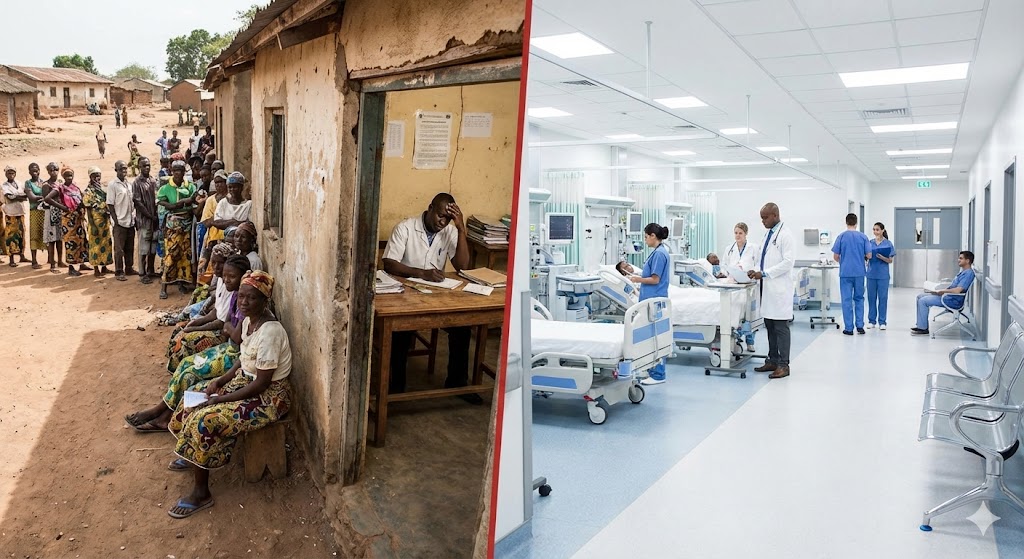
Health services in many African countries remain concentrated in urban areas. Rural populations often face longer travel times, fewer skilled health workers, and limited diagnostic capacity. These geographic barriers compound poverty and delay care-seeking, especially for maternal, newborn, and emergency services.
3. Gender Inequality
Gender norms and power imbalances continue to shape health outcomes. Women and girls often face limited autonomy over health decisions, restricted access to financial resources, and unequal exposure to health risks particularly in sexual and reproductive health.
As a result, maternal health outcomes vary sharply by wealth, education, and place of residence, even within the same country.
Health Inequality in Uganda: A Concrete Example
Uganda clearly demonstrates why expanding facilities alone does not guarantee equitable outcomes. While the country has invested heavily in primary health care infrastructure, socioeconomic disparities continue to determine who benefits most from available services.
Analysis of Demographic and Health Survey data shows stark inequalities in maternal health care utilization. Women from the wealthiest households are more than twice as likely to deliver with a skilled birth attendant compared to women from the poorest households. Approximately three-quarters of women in the highest wealth quintile deliver with skilled assistance, compared to fewer than one-third among the poorest quintile.
Crucially, these gaps persist even in regions where physical proximity to health facilities is similar, pointing to non-geographic barriers such as transport costs, informal fees, limited decision-making power, and low health literacy.
Uganda’s experience underscores a critical lesson: health inequality is driven as much by social and economic conditions as by service availability.
Policy Levers for Reducing Health Inequality
1. Strengthening Primary Health Care with an Equity Lens
Health systems must focus not only on coverage, but also on quality, continuity, and affordability of care, especially for marginalized populations.
2. Addressing the Social Determinants of Health
Reducing inequality requires action beyond the health sector. This includes integrating nutrition interventions into social protection programmes, improving access to clean water and sanitation, and ensuring that school curricula include practical health literacy to support informed health choices across the life course.
3. Using Disaggregated Data for Targeted Action
The WHO emphasizes the importance of disaggregated health data by income, gender, age, disability, and geography to identify who is being left behind and to design responsive, targeted interventions (WHO Health Inequality Monitor).
4. Community-Led and Gender-Responsive Approaches
Equity-focused health systems must actively engage communities. This includes training and supporting community health worker networks to bridge the “last mile”—not only physically, but culturally and linguistically. Such approaches improve trust, uptake, and sustainability, particularly for women and rural populations.
From Coverage to Equity: A Necessary Shift
Expanding access to health services is a vital achievement but it is only the starting point. Persistent inequalities reveal that health outcomes are shaped long before people reach a clinic.
Without addressing poverty, education, gender norms, and living conditions, health systems will continue to treat symptoms rather than causes.
Conclusion: Health Equity, Not Just Health Coverage
Health inequality in Africa is not simply a question of how many facilities exist or how many services are delivered. It is about who can benefit from those services, and under what conditions.
Reducing inequality requires investing in the systems and social conditions that create health, not just in the clinics that treat disease. The ultimate goal must be health equity—not merely health coverage.
Only by tackling the structural drivers of inequality can African countries ensure that progress in health truly leaves no one behind.