✍️ Authored by Ojiambo Elivin Masiga | Population and Demographic Research
📌 Shaping Africa’s Future with Evidence, Equity, and Innovation for Impact
Why Africa’s fastest-growing population could become its greatest economic asset or its biggest development challenge
📌 Shaping Africa’s Future with Evidence, Equity, and Innovation for Impact
Why Africa’s fastest-growing population could become its greatest economic asset or its biggest development challenge
Every second, the world changes. Recent global estimates reported around 4.2 births and 2.0 deaths per second, meaning the world’s population is still growing, even as growth patterns differ sharply across regions.
According to the United Nations’ World Population Prospects 2024, the global population is estimated at about 8.2 billion in 2024 and is projected to peak at around 10.3 billion in the mid-2080s, before slightly declining to about 10.2 billion by the end of the century.
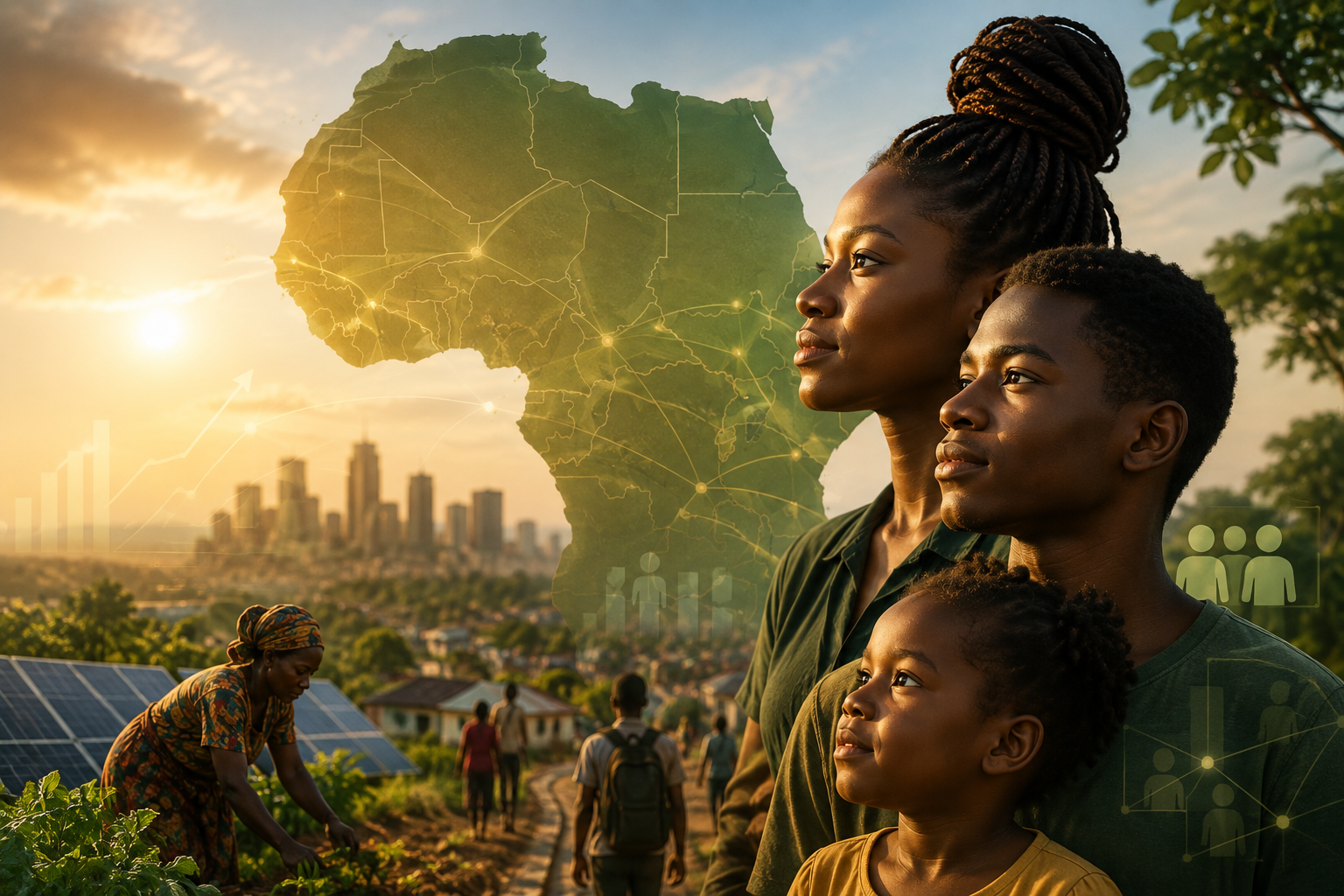
But the real demographic story is not only about global numbers. It is about where population growth is happening, who is being added to the population, and whether countries are prepared to transform that growth into human capital, productive work, and shared prosperity.
For Africa, especially sub-Saharan Africa, this is either one of the continent’s greatest development opportunities or one of its biggest tests.
Sub-Saharan Africa is projected to experience significant population growth, rising by 79% to 2.2 billion by 2054, and reaching about 3.3 billion by the end of the century. This growth is not automatically good or bad. Its meaning will depend on what countries do now.
Population growth is not destiny. It is a choice between investing in people today or paying the cost of missed opportunities tomorrow.
A Human Story Behind the Numbers
Imagine a young woman in northern Uganda who has completed secondary school and dreams of becoming an entrepreneur. She is healthy, ambitious, and eager to contribute to her family, community, and country. But she struggles to access vocational training, affordable financing, business mentorship, or decent employment.
Her story reflects the reality of millions of young Africans.
They are not simply part of a growing population. They are potential teachers, farmers, nurses, innovators, technicians, entrepreneurs, researchers, and leaders. Whether they become drivers of economic growth or victims of unemployment, poverty, and exclusion depends largely on the decisions made today.
Population growth is therefore not just a demographic issue. It is a development issue. It is about education systems, health systems, labour markets, urban planning, food systems, climate resilience, gender equality, and governance.
Why Population Growth Matters Now
Population growth is shaping the future of development more than ever before.
In many developing countries, population growth is driven by declining mortality, improved child survival, better healthcare, and relatively high fertility. These are partly signs of progress. More children are surviving. More families are benefiting from improved health systems. More people are living longer.
But population growth also increases demand.
More people means greater need for schools, teachers, health facilities, housing, food, water, sanitation, transport, social protection, jobs, and public infrastructure. If public investment keeps pace, population growth can support economic transformation. If investment falls behind, population growth can place serious pressure on households, communities, and governments.
This is why population growth should not be treated as either a blessing or a crisis by itself. It becomes an opportunity or a challenge depending on the quality of planning, investment, and governance.
Population Growth: Opportunity or Challenge?
The answer is both.
A growing population can become one of a country’s greatest economic assets. A larger working-age population can expand the labour force, stimulate domestic markets, increase demand for goods and services, support innovation, and create opportunities for entrepreneurship.
This is the foundation of the demographic dividend the economic growth that can occur when the share of the working-age population grows faster than the dependent population.
The IMF describes Africa’s rising working-age population as a window of opportunity that can translate into higher growth if properly harnessed. However, it also emphasizes that this depends on supportive policies, especially those that foster human capital accumulation and job creation.
But the demographic dividend is never automatic.
A large working-age population does not create prosperity on its own. If young people are not educated, healthy, skilled, and productively employed, population growth can become a source of pressure rather than progress.
This is the central choice facing many developing countries: population growth can become an economic asset if it is matched with investment in people, or a development challenge if public systems and economies fail to keep pace.
The Opportunity: A Larger Labour Force and Bigger Markets
One major benefit of population growth is the expansion of the labour force.
When more people reach working age, countries have the potential to produce more goods, deliver more services, generate more tax revenue, and strengthen domestic markets. A growing population can also increase demand for housing, food, transport, technology, education, healthcare, and consumer goods, creating new opportunities for businesses and investors.
For Africa, this could be transformative.
A young and growing population can drive innovation, entrepreneurship, digital transformation, agricultural modernization, industrialization, and service-sector growth. But this requires deliberate investment in the capabilities of people.
Education matters. Skills matter. Health matters. Jobs matter. Institutions matter.
Without these, a growing labour force may simply become a growing population of unemployed or underemployed people.
The Challenge: Services, Jobs, and Infrastructure Under Pressure
Population growth becomes a challenge when economic and social systems cannot keep up.
Across many developing countries, governments already face pressure to provide quality education, healthcare, housing, water, sanitation, transport, and employment. Rapid population growth increases this pressure.
If classrooms become overcrowded, learning outcomes decline. If health facilities are underfunded, access to care weakens. If cities grow without planning, informal settlements expand. If young people enter the labour market faster than jobs are created, unemployment and underemployment rise.
This is especially important for Africa because the continent’s youth population is large and still growing.
In other words, population growth can widen opportunity but only if governments invest ahead of demand.
What This Means for Uganda
Uganda offers a clear example of both promise and risk.
According to Uganda’s National Population and Housing Census 2024, 25,494,490 people, representing 57.4% of the population, were in the working-age group of 15 years and above. This gives Uganda a strong demographic foundation for economic transformation.
But Uganda also faces a serious youth exclusion challenge. Youth aged 18–30 years who are not in employment, education, or training were estimated at 5,250,768, representing 50.9%.
Uganda has 5.25 million young people aged 18–30 who are not in employment, education, or training. That is not just a statistic. It is a generation waiting to be unlocked.
This means Uganda’s demographic opportunity is real, but fragile.
The country has a large young population that could drive productivity, innovation, enterprise, and national development. But if millions of young people remain outside school, work, and training, the demographic dividend could be delayed, weakened, or missed.
For Uganda, population growth is therefore not just about numbers. It is about whether every child can learn, every young person can acquire relevant skills, every woman can access reproductive health services, every entrepreneur can access opportunity, and every working-age person can contribute productively to national development.
Family Planning and Reproductive Health Are Part of the Economic Agenda
Population growth cannot be discussed without discussing reproductive health, family planning, and women’s empowerment.
Voluntary family planning allows women and couples to decide whether and when to have children. This supports healthier pregnancies, better birth spacing, continued education, women’s participation in work, and improved household investment in children.
It also supports the demographic transition. When fertility declines gradually and voluntarily, dependency pressure can reduce over time. This creates better conditions for families and governments to invest more in each child’s health, education, and future.
This does not mean population growth should be approached through coercion or control. It means people should have access to information, services, rights, and choices.
A country that invests in family planning, girls’ education, maternal health, and women’s economic empowerment is not only investing in health. It is investing in long-term development.
Education and Skills Turn Population into Productivity
A growing population becomes an asset only when people have the skills to participate productively in the economy.
Education is one of the most important investments a country can make in the context of population growth. It improves employability, productivity, innovation, income, health, and civic participation. But education must also be relevant to labour market realities.
Young people need more than certificates. They need practical skills, digital literacy, technical training, entrepreneurship, problem-solving capacity, and pathways into decent work.
For developing countries, this means strengthening early childhood development; primary and secondary education; technical and vocational education; digital skills; agricultural training; entrepreneurship support; apprenticeships and internships; and lifelong learning.
The IMF has warned that sub-Saharan Africa’s growing population requires major investments in education to unlock the potential of young people and prepare them for future jobs.
Without skills, population growth can increase unemployment. With skills, it can expand productivity.
Jobs Are the Decisive Test
The demographic dividend is ultimately realized through work.
A young population can only support growth if young people have access to productive, decent, and meaningful employment. This is where many developing countries face one of their biggest challenges.
Economic growth alone is not enough if it does not create jobs. A country may record GDP growth while young people remain unemployed, underemployed, or trapped in low-productivity informal work.
Developing countries therefore need job-rich growth. This means investing in sectors that can absorb labour and raise productivity, such as agriculture, agro-processing, manufacturing, construction, tourism, care work, digital services, green industries, and small and medium enterprises.
It also means supporting young entrepreneurs with finance, mentorship, markets, infrastructure, and an enabling business environment.
Without jobs, population growth becomes pressure. With jobs, it becomes productivity.
Urbanization Must Be Planned, Not Just Managed
Population growth is also reshaping Africa’s cities.
As more people move to urban areas in search of education, employment, services, and opportunity, cities can become engines of growth. Well-planned cities can connect people to jobs, markets, innovation, healthcare, education, and public services.
But when urbanization is not planned, population growth can produce overcrowded settlements, poor sanitation, traffic congestion, housing shortages, flooding, pollution, and unequal access to services.
For Africa, the lesson is clear: urbanization should not simply be managed after it happens. It must be planned ahead of time through affordable housing, reliable transport, drainage systems, waste management, green spaces, digital infrastructure, and climate-resilient urban design.
Population growth should not only expand cities. It should push countries to build better cities.
Climate Change Adds Another Layer of Urgency
Population growth is happening in a climate-stressed world.
Many of Africa’s fastest-growing communities are also exposed to droughts, floods, heat stress, food insecurity, water scarcity, and climate-related displacement. The IPCC notes that climate-related hazards in Africa already have multi-sector impacts, including reduced crop production, migration and displacement, food insecurity, livestock losses, electricity outages, and health risks. It also projects that future warming will have substantial adverse implications for food security in Africa.
This means the demographic dividend must also be climate resilient.
A growing population will need resilient food systems, climate-smart agriculture, water security, planned urbanization, green jobs, renewable energy, and disaster preparedness. For Uganda, the World Bank has noted that climate-smart agriculture, solar irrigation, renewable energy, e-mobility, and green building can support food security, energy access, livable cities, jobs, and economic growth.
A demographic dividend that is not climate-resilient will not be sustainable.
Africa Must Also Plan for Ageing
Africa is young today, but it will not remain young forever.
As fertility declines and life expectancy improves, population ageing will eventually become a major policy issue across the continent. Today’s children and young workers will become tomorrow’s older persons.
This means that planning for population growth must also include planning for ageing. Countries need to think ahead about pensions, healthcare, long-term care, social protection, age-friendly infrastructure, and support for older persons.
A serious population strategy should prepare for both youth opportunity today and ageing realities tomorrow.
Governance Determines the Outcome
Population growth becomes opportunity when institutions are prepared.
This requires long-term planning, strong data systems, effective budgeting, and coordination across sectors. Population dynamics should inform national development plans, district plans, education budgets, health systems, labour market strategies, urban planning, climate adaptation, and social protection.
Governments need to ask: Where is the population growing fastest? Which age groups are growing most rapidly? Where will new schools and health facilities be needed? How many young people will enter the labour market each year? Which skills will the economy require? Which cities and districts need urgent infrastructure investment? Which groups are being left behind?
Good demographic data helps countries plan. But data only matters if it shapes decisions.
The challenge is not population growth itself. The challenge is whether governments use evidence to plan for it.
What This Means
For government: Prioritize investments in education, healthcare, employment creation, reproductive health, urban planning, climate resilience, and population-responsive development policies that transform demographic growth into economic growth.
For development partners: Support long-term investments in human capital, youth employment, reproductive health services, climate adaptation, data systems, and evidence-informed policymaking.
For civil society: Advocate for equitable access to education, health services, decent work, family planning, social protection, and accountability in public investments.
For researchers: Generate timely evidence on population dynamics, labour markets, urbanization, migration, climate vulnerability, fertility transition, and demographic dividend policies.
For the private sector: Create decent jobs, invest in skills development, support young entrepreneurs, expand apprenticeships, and build industries that can absorb Africa’s growing labour force.
For communities and young people: Invest in education and skills, embrace innovation and entrepreneurship, participate in civic engagement, and demand policies that create opportunities for productive livelihoods.
Key Takeaways
● Population growth is not destiny; it becomes an opportunity or a challenge depending on policy choices.
● A growing workforce can drive economic growth, but only when people are healthy, educated, skilled, and productively employed.
● Family planning and women’s empowerment are central to the demographic transition and long-term development.
● Urbanization must be planned, not simply managed after cities become overcrowded.
● Climate resilience is essential because a demographic dividend that is not climate-resilient will not be sustainable.
● Ageing should be anticipated early because Africa’s young population today will eventually become an older population.
● Governance determines the outcome: strong institutions can turn population growth into opportunity, while weak systems can turn it into pressure.
The Way Forward
Population growth should no longer be viewed only as a problem to be controlled. It should be understood as a development reality to be managed strategically.
For developing countries, especially in Africa, the future will not be determined by population size alone. It will be shaped by whether countries invest in people, create jobs, empower women, expand access to reproductive health, strengthen education systems, plan cities, protect the environment, and build resilient institutions.
Countries that align demographic change with economic transformation will be better positioned to achieve inclusive growth, reduce poverty, and build resilient societies.
Those that fail to plan may face rising unemployment, overstretched services, environmental pressure, urban strain, and widening inequality.
Population growth is not destiny.
It is a choice.
The choice is whether to invest in people today or pay the cost of missed opportunities tomorrow.
Sources and Further Reading
United Nations Department of Economic and Social Affairs. World Population Prospects 2024: Summary of Results. This source supports the global population estimate of 8.2 billion in 2024 and the projection that the world population will peak at about 10.3 billion in the mid-2080s.
United Nations DESA. Leveraging population trends for a more sustainable and inclusive future: Insights from World Population Prospects 2024. This source supports the projection that sub-Saharan Africa’s population will rise by 79% to 2.2 billion by 2054 and reach 3.3 billion by the end of the century.
International Monetary Fund. Africa Rising: Harnessing the Demographic Dividend. This source supports the argument that Africa’s rising working-age population creates a window of opportunity, but that the dividend depends on human capital, job creation, and supportive policies.
Uganda Bureau of Statistics. National Population and Housing Census 2024 Final Report, Volume 1: Main Report. This source supports Uganda’s working-age population and youth NEET statistics used in the Uganda section.
Intergovernmental Panel on Climate Change. Climate Change 2022: Impacts, Adaptation and Vulnerability, Chapter 9: Africa. This source supports the discussion on climate risks, food security, displacement, and vulnerability in Africa.
World Bank. Embracing Climate-Smart Growth is a Net Win for Uganda. This source supports the argument that climate-smart investments can strengthen jobs, food security, energy access, and livable cities in Uganda.