✍️ Authored by the ACSPR Team | Health & Well being
📌 Shaping Africa’s Future with Evidence, Equity, and Innovation for Impact
📌 Shaping Africa’s Future with Evidence, Equity, and Innovation for Impact
Why Health Systems Succeed or Fail at the Community Level
Across Africa, investments in hospitals, equipment, and national health programs have expanded significantly over the past two decades. While these investments are essential, millions of people still struggle to access timely, affordable, and quality care.
Strong health systems are ultimately built from the community level upward. Where primary care is weak, trust is low, and services fail to reach households, even the most advanced hospitals cannot deliver population health.
Community-centered health systems, those that prioritize primary health care, community health workers, prevention, and local engagement have consistently emerged as one of the most effective strategies for improving health outcomes and advancing equity across the continent.
The Central Role of Primary Health Care
Primary health care serves as the foundation of strong health systems.
Research from the World Health Organization shows that well-functioning primary health care systems can address over 80 percent of a population’s health needs, while delivering better outcomes at lower cost and with greater equity.
Primary care offers continuity of services, early disease detection, prevention, and a trusted entry point into the broader health system. It is where most health needs are met and where health systems either succeed or fail.
Yet across many African countries, community-level services remain underfunded and overstretched. Shortages of frontline health workers, weak financing for prevention, and limited integration into national systems continue to undermine the effectiveness of care in rural and underserved areas.
Why Community-Centered Solutions Deliver Better Outcomes
Community-centered approaches work because they bring care closer to where people live and align services with local realities.
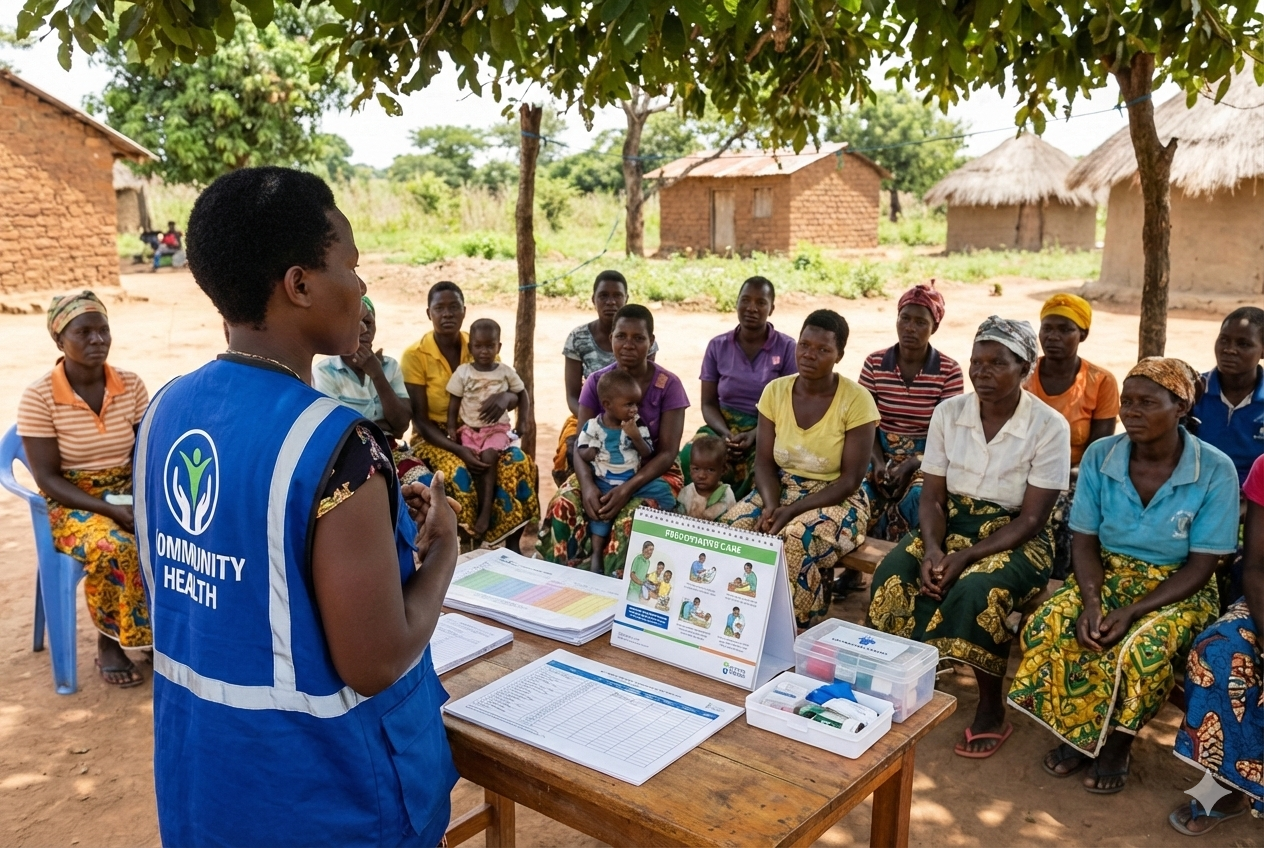
Community health workers provide maternal and child health services, follow up on immunizations, monitor disease outbreaks, support family planning, and offer basic treatment and referrals. These services dramatically reduce delays in seeking care and prevent minor illnesses from becoming life-threatening.
Equally important is trust.
Community-based providers speak local languages and understand cultural contexts. They also help reduce stigma around sensitive health issues such as reproductive health, mental illness, and HIV. This trust leads to earlier care-seeking, better adherence to treatment, and improved long-term health outcomes.
Prevention is another major strength. Community systems emphasize health education, early detection, sanitation, and behavior change. Evidence consistently shows that prevention-focused primary care lowers maternal mortality, child deaths, and the burden of communicable diseases more sustainably than hospital-centered models alone.
Visualizing a People-Centered Health System
A strong health system can be imagined as a pyramid:
At the broad base: Community health workers and primary health care services providing prevention, early treatment, education, and referrals.
At the middle level: Health centers offering more advanced care and diagnostics.
At the top: Hospitals delivering specialized and emergency services.
When the base is weak, the entire system becomes overloaded and ineffective. When communities are strong and well-supported, hospitals function better and overall health outcomes improve.
Uganda’s Experience with Community Health Systems
Uganda offers a clear illustration of community-centered care through its Village Health Teams (VHTs), which serve as the first point of contact for millions of households across the country.
Led by the Ministry of Health Uganda, the VHT program supports maternal health, child immunization, malaria prevention, sanitation, and community disease surveillance.
Evaluations by government and development partners show that VHTs have contributed to increased antenatal care attendance, improved immunization coverage, earlier treatment for childhood illnesses, and stronger local health monitoring.
In real terms, this means health services now reach vulnerable families before complications escalate not only when they arrive at distant facilities.
The Cost of Neglecting Community-Level Care
When community and primary care systems are weak, the consequences are immediate:
● Preventable illnesses escalate into emergencies.
● Hospitals become overcrowded.
● Household health costs rise.
● Rural and poor populations are left behind.
● Hospitals become overcrowded.
● Household health costs rise.
● Rural and poor populations are left behind.
Health systems that prioritize curative hospital services without strong community foundations struggle to deliver equitable, affordable, and sustainable outcomes especially in contexts of rapid population growth and climate-related health threats.
Evidence-Based Community Models That Work Across Africa
Across the continent, countries that have invested in strong community health worker programs have achieved remarkable improvements.
Large-scale community initiatives in Ethiopia, Rwanda, and Malawi have driven major reductions in child mortality and strengthened maternal health outcomes. Integrated primary care models that combine nutrition, family planning, disease prevention, and maternal services have proven particularly effective.
Digital innovations including mobile reporting systems, electronic referrals, and teleconsultation are further strengthening frontline care by improving supervision, real-time data use, and rapid response.
Why Community-Centered Health Is a Development Strategy
Community-centered health systems are not simply about delivering care. They are a foundation for development.
Strong primary care:
● Reduces preventable deaths
● Improves productivity
● Lowers household medical costs
● Strengthens resilience to outbreaks and climate shocks
● Advances equity in access
● Improves productivity
● Lowers household medical costs
● Strengthens resilience to outbreaks and climate shocks
● Advances equity in access
When communities are healthy, economies grow stronger and social systems become more resilient.
ACSPR’s Contribution to Building Stronger Health Systems
At ACSPR, we generate community-level evidence on health access barriers, vulnerable populations, service delivery effectiveness, and equity gaps to support people-centered health system strengthening across Africa.
Our work informs policies and programs that prioritize frontline workers, prevention-focused care, inclusive service delivery, and data-driven planning all essential for building resilient health systems from the ground up.
Health Begins Where People Live
Hospitals save lives but communities sustain health.
The future of Africa’s health systems lies not only in advanced facilities, but in trusted, accessible, and well-supported care at the community level.
When health systems are strengthened from the ground up, they become more equitable, more resilient, and more effective, ensuring that every person has the opportunity to live a healthy and productive life.