
✍️ Authored by the ACSPR Team | AI, Data & Digital Governance
📌 Shaping Africa’s Future with Evidence, Equity, and Innovation for Impact
📌 Shaping Africa’s Future with Evidence, Equity, and Innovation for Impact
Data: Africa’s New Development Currency
Across Africa, data has become one of the most powerful forces shaping development. Governments are digitising public services, development partners are investing heavily in data systems, and digital platforms are transforming how people access finance, health care, education, and social protection.
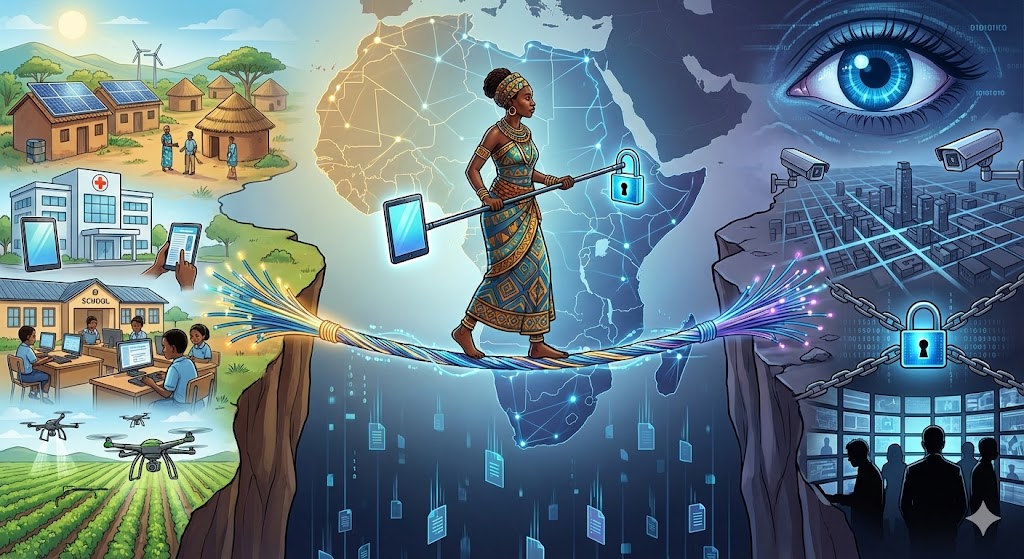
But alongside this promise lies a growing tension: is data being used to empower people or to monitor, exclude, and control them?
This tension defines Africa’s digital moment. Technology is advancing rapidly, but governance frameworks are struggling to keep pace. The result is a digital tightrope where the same systems that can accelerate development can also deepen inequality and erode trust if left unchecked.
Africa’s Rapid Digital Expansion
Africa’s digital transformation is accelerating at unprecedented speed.
According to the International Telecommunication Union, internet use in Africa has risen from under 10% of the population in 2010 to over 40% by 2023, largely driven by mobile connectivity. Mobile phones now underpin access to banking, health information, humanitarian assistance, and government services.
At the same time, governments and development actors increasingly rely on:
- ● Digital identification systems
- ● Biometric voter and beneficiary registers
- ● Mobile money platforms
- ● Data-driven targeting of social protection programmes
Globally, the World Bank estimates that over one billion people are now covered by some form of digital ID system, with rapid expansion across low- and middle-income countries.
The Development Promise of Data
When governed responsibly, data can be transformative.
1. Better Targeting and Efficiency
Data enables governments to identify who needs support and where. Digital registries can reduce duplication, improve targeting, and ensure limited resources reach those most in need.
2. Improved Health and Education Systems
According to the World Health Organization, digital health systems strengthen disease surveillance, service delivery, and health system resilience when privacy and safeguards are in place.
3. Transparency and Accountability
Open data platforms and digital public services can enhance accountability by enabling citizens to track spending and service delivery provided access is equitable and oversight is strong.
When Data Becomes a Tool of Control
Without governance, the same tools that promise inclusion can produce exclusion.
1. Surveillance Without Safeguards
The Freedom House reports that at least 70 countries now use digital technologies for mass surveillance. In contexts with weak legal protections, such practices risk undermining privacy, civic space, and freedom of expression.
2. Exclusion Through Digital Systems
The World Bank estimates that around 850 million people globally lack official identification, many of them poor, rural, displaced, elderly, or persons with disabilities. When access to services is tied rigidly to digital systems, these populations risk being excluded.
3. Algorithmic Bias
According to UNESCO, AI systems can reinforce discrimination when trained on biased or incomplete data especially in settings with limited oversight and transparency.
Uganda: Digital Progress, Governance Gaps
Uganda illustrates both the promise and risks of data-driven development.
The country has invested heavily in biometric national identification, digital voter registers, and mobile-enabled service delivery platforms. These systems have improved administrative efficiency and service targeting in several sectors.
However, governance gaps remain visible. Instances of service denial due to biometric verification failures, alongside concerns about data sharing without explicit and informed consent, have highlighted vulnerabilities in data protection and oversight. For some citizens particularly the elderly, rural populations, and informal workers digital efficiency has come at the cost of access and trust.
Uganda’s experience underscores a broader lesson for Africa: technology can outpace governance if safeguards are not designed in from the start.
Why Governance Must Catch Up with Technology
1. Laws Are Lagging Behind Innovation
While data collection and AI use are expanding rapidly, many African countries still lack comprehensive data protection laws or effective enforcement. According to UNESCO, only about half of African countries have enacted personal data protection legislation.
2. Development Without Rights Is Unsustainable
The United Nations emphasizes that digital transformation must be grounded in human rights, accountability, and transparency. Development gains achieved without trust are fragile.
3. Trust Is the Foundation of Data Systems
People are more willing to share data when they trust institutions. Weak governance erodes this trust and ultimately undermines the effectiveness of digital development programmes.
Building Data Governance for Development (Not Control)
To ensure data serves development rather than control, governance must evolve alongside technology.
✔ Strong Legal Frameworks
Clear data protection laws that define consent, purpose limitation, and accountability such as laws that explicitly restrict secondary use of personal data without consent.
✔ Independent Oversight
Empowered data protection authorities with the resources to audit systems, investigate breaches, and enforce compliance.
✔ Ethical AI and Algorithmic Transparency
Requirements for explainability and bias assessment such as human review of automated decisions in social protection or credit scoring toggle systems.
✔ Inclusion by Design
Digital systems must work for those without smartphones or connectivity for example, allowing social protection registries to be accessed and updated through trained community agents, not only mobile apps.
✔ Evidence-Based and Adaptive Policy
Continuous impact assessments and learning loops that allow policies to adjust as technologies evolve.
Institutions like ACSPR play a critical role in generating evidence, convening dialogue, and shaping African-led data governance frameworks.
The Path Forward: Innovating Governance, Not Just Technology
Data is neither inherently empowering nor inherently oppressive. Its impact depends on the rules, institutions, and values that govern its use.
Ensuring data serves development requires innovation in governance itself including regulatory sandboxes, participatory system design, and adaptive oversight models that keep pace with technological change without stifling innovation.
Africa’s digital future will not be determined by technology alone, but by whether governance frameworks can evolve fast enough to protect rights, promote inclusion, and build trust.
The question is no longer whether Africa will be data-driven but whether it will be data-just.