✍️ Authored by the ACSPR Team | Education & Skills Development
📌 Shaping Africa’s Future with Evidence, Equity, and Innovation for Impact
Why Learning - Not Schooling Alone - Defines Development
📌 Shaping Africa’s Future with Evidence, Equity, and Innovation for Impact
Why Learning - Not Schooling Alone - Defines Development
Over the past two decades, African countries have made notable progress in expanding access to education. School enrolment has increased, gender gaps have narrowed, and more children are entering classrooms than ever before. Yet beneath these gains lies a troubling reality: millions of children are in school but not learning.
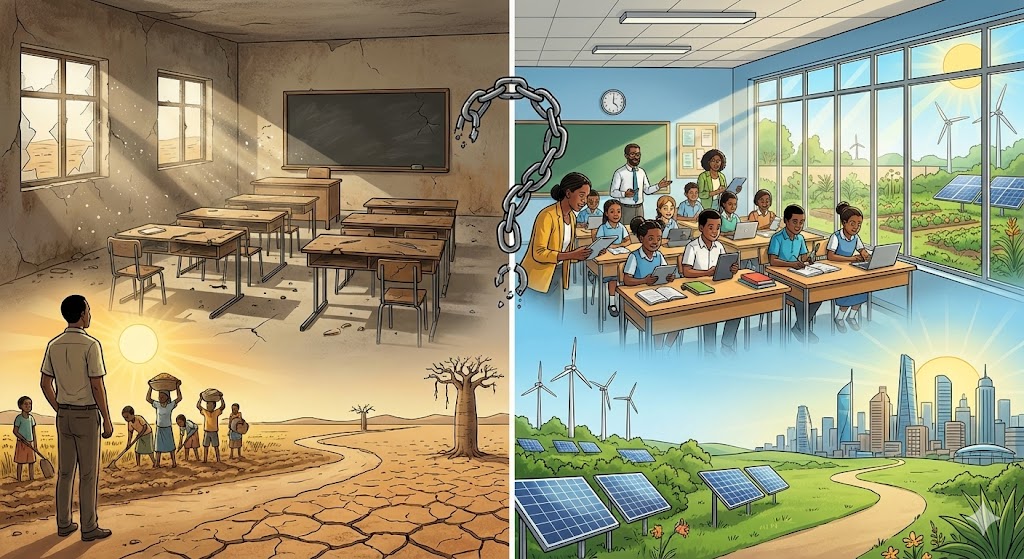
This gap between schooling and learning represents one of the most urgent and under-addressed development challenges of our time. Education systems that fail to deliver foundational skills do not build human capital, reduce inequality, or support economic transformation. The result is an empty classroom crisis: schools that exist but learning that does not.
As the World Bank consistently emphasizes, learning outcomes - not years of schooling - are what ultimately drive development.
The Learning Crisis in Numbers
The scale of the learning crisis is stark and well documented:
- ● According to UNESCO, more than 250 million children globally lack basic literacy and numeracy skills, even after attending school.
- ● The World Bank estimates that 70% of children in low- and middle-income countries cannot read and understand a simple text by age 10, a condition known as learning poverty.
- ● In Sub-Saharan Africa, learning poverty exceeds 85% in many countries, the highest level in the world.
These figures reveal a critical truth: education access without learning is not development, it is delayed inequality.
Why Learning Inequality Is a Development Crisis
1. Slower Economic Growth and Productivity
Education is central to economic growth, but only when learning occurs. The World Bank estimates that poor learning outcomes result in trillions of dollars in lost lifetime earnings globally, weakening productivity and competitiveness.
Countries cannot build skilled workforces or knowledge economies when foundational learning fails.
2. Inequality That Starts Early and Persists
Learning gaps emerge early and widen over time. Children from poorer households, rural areas, and overcrowded public schools are consistently left behind not due to ability, but due to systemic disadvantage.
This entrenches intergenerational poverty, limiting social mobility and undermining inclusive development.
3. Youth Unemployment and Skills Mismatch
When education systems fail to build literacy, numeracy, and problem-solving skills, young people enter labour markets unprepared. This fuels youth unemployment, underemployment, and informality, even among those with formal qualifications.
Uganda: Access Achieved, Learning Still Unequal
Uganda clearly illustrates the learning paradox.
The country has made major investments in universal primary and secondary education, resulting in high enrolment rates. However, learning outcomes remain uneven and inequitable.
For example, the 2021 National Assessment of Progress in Education (NAPE) revealed that less than half of Primary 3 pupils met the required competency benchmark in English literacy. This foundational skills gap means many learners progress through the system without mastering basic reading and comprehension skills essential for all future learning.
Learning challenges are most pronounced among:
- ● Children in rural and hard-to-reach areas
- ● Learners from low-income households
- ● Overcrowded schools with limited instructional support
Uganda’s experience shows that education inequality is not about access alone, but about what happens inside the classroom.
Why Evidence Is the Key to Fixing Education Inequality
Addressing the learning crisis requires moving beyond assumptions to evidence-driven action.
1. Measure What Matters
Too often, education systems track enrolment and completion while overlooking learning. Early grade reading and mathematics assessments, classroom observations, and learner-level data reveal where and why learning breaks down.
2. Target Resources Where Learning Gaps Are Greatest
Disaggregated data by region, gender, disability, and socioeconomic status allows policymakers to focus resources on the learners most at risk, rather than applying uniform reforms that miss the most vulnerable.
3. Use Evidence-Based Instructional Reforms
Evidence shows that interventions such as structured lesson plans combined with targeted teacher coaching can dramatically improve learning outcomes. Literacy programs using this approach in countries such as Kenya and Ghana have demonstrated measurable gains in reading skills at scale.
These successes show that the learning crisis is solvable when policy follows evidence.
4. Embrace Innovation in Education Data
Fixing education inequality also requires innovation. This includes leveraging real-time classroom monitoring, citizen-led assessments, and digital data platforms to complement traditional surveys providing faster feedback loops and more responsive decision-making.
From Empty Classrooms to Learning Systems
The learning crisis is not inevitable. Countries that prioritize foundational learning, teacher support, and evidence-based reform have shown that progress is possible even in low-resource settings.
For Africa, addressing education inequality is essential to:
- ● Harnessing the demographic dividend
- ● Reducing poverty and inequality
- ● Building resilient, future-ready economies
Institutions like ACSPR play a critical role in translating education data into actionable policy insights, ensuring reforms are grounded in local realities and scalable evidence.
The Path Forward
Education is one of the most powerful tools for development but only if it delivers learning.
The learning crisis is a development crisis. Fixing it requires evidence, innovation, and equity-focused policy choices. When learning improves, development follows.
Schooling without learning fails Africa’s future. Evidence-driven education can unlock it.