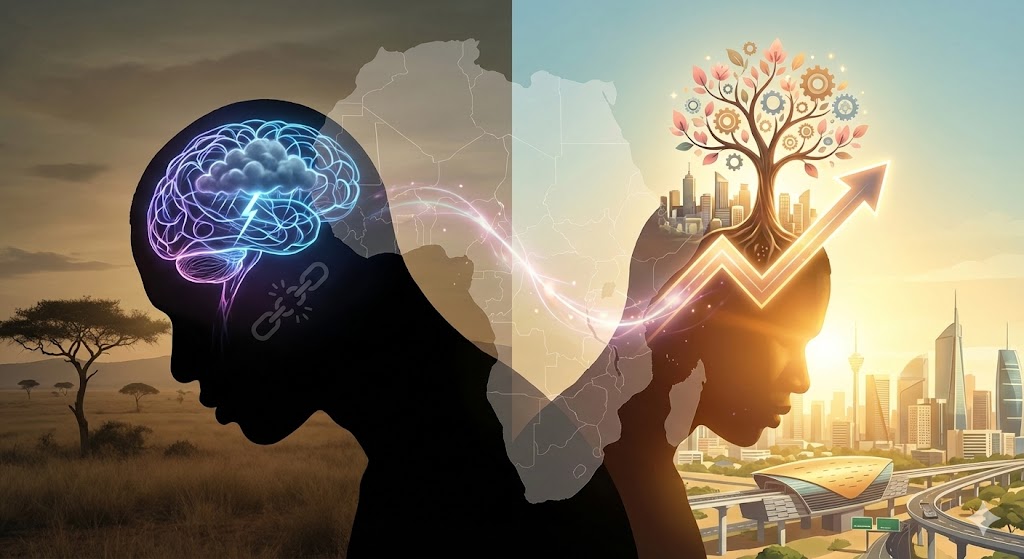
Moving Mental Health from the Margins to the Core of the Agenda
✍️ Authored by the ACSPR Team | Health & Well-being
📌 Shaping Africa’s Future with Evidence, Equity, and Innovation for Impact
✍️ Authored by the ACSPR Team | Health & Well-being
📌 Shaping Africa’s Future with Evidence, Equity, and Innovation for Impact
Mental Health: The Overlooked Development Challenge
Across Africa, development strategies have traditionally prioritised infectious diseases, maternal and child health, and more recently non-communicable diseases. These investments have delivered important gains. Yet one critical pillar of human development remains persistently overlooked: mental health.
This omission comes at a cost. Mental health conditions undermine productivity, learning, social cohesion, and economic resilience. Evidence increasingly shows that mental health is not a side issue it is a core development issue.
This blog examines why mental health must move from the margins to the centre of Africa’s health and development agenda, drawing on regional evidence and the Ugandan experience.
The Scale of the Invisible Crisis
Mental health conditions are among the leading causes of disability worldwide. According to the World Health Organization (WHO):
- ● Nearly 1 in 8 people globally live with a mental disorder
- ● Depression and anxiety cost the global economy an estimated US$1 trillion annually in lost productivity
- ● Mental, neurological, and substance use disorders account for over 10% of the global burden of disease
In Africa, the treatment gap is particularly stark. The WHO estimates that more than 85% of people with mental health conditions in Africa receive no treatment, due to underfunding, stigma, and weak service delivery systems.
Why Mental Health Is a Development Issue
1. Economic Productivity and Poverty Reduction
Poor mental health reduces labour participation and income generation. The World Bank identifies depression as one of the leading causes of productivity loss globally, with particularly severe impacts in low- and middle-income countries where safety nets are limited.
Untreated mental health conditions increase household vulnerability, deepen poverty, and slow economic growth.
2. Education and Human Capital
Mental health conditions often begin early in life. The WHO reports that 50% of mental health conditions start before age 14, and 75% by the mid-20s.
Among children and adolescents, poor mental health is associated with:
- ● School absenteeism and dropout
- ● Lower learning outcomes
- ● Increased risk of substance use and violence
This directly undermines human capital formation—one of Africa’s most critical development assets.
3. Health Systems and Universal Health Coverage
Mental health is deeply interconnected with physical health. The WHO documents strong links between mental health and:
- ● HIV and TB treatment adherence
- ● Maternal health outcomes
- ● Non-communicable diseases such as diabetes and cardiovascular disease
Health systems that neglect mental health struggle to deliver effective, holistic care undermining progress toward Universal Health Coverage (UHC).
Uganda: Mental Health, Inequality, and Opportunity
Uganda reflects many of the mental health challenges facing African countries.
According to the Ministry of Health Uganda, mental health conditions are among the leading causes of years lived with disability nationally. Yet Uganda has fewer than one mental health worker per 100,000 people, far below WHO recommendations, with services concentrated in urban referral hospitals.
At the same time, Uganda also demonstrates what is possible with community-led, evidence-based innovation.
One notable example is StrongMinds, a Uganda-based organization delivering group interpersonal therapy for women with depression. Randomized controlled trials and independent evaluations have shown that StrongMinds’ low-cost, scalable model leads to substantial and sustained reductions in depressive symptoms, while improving social and economic functioning. This evidence highlights a critical lesson: effective mental health care is possible even in low-resource settings when interventions are contextually grounded and evidence-driven.
Why Mental Health Remains Marginalised
Despite its importance, mental health remains under prioritised across much of Africa.
1. Chronic Underfunding
The WHO reports that African countries allocate less than 1% of national health budgets to mental health on average insufficient to meet population needs.
2. Stigma and Low Political Visibility
Mental illness is still widely misunderstood and stigmatised, often framed as a moral or spiritual issue rather than a public health and development concern.
3. Weak Data Systems
Mental health indicators are poorly integrated into routine health information systems, limiting planning, budgeting, and accountability.
What Evidence Shows Works
1. Integrating Mental Health into Primary Health Care
The WHO’s Mental Health Gap Action Programme (mhGAP) provides strong evidence that training non-specialist health workers improves identification and management of common mental health conditions. Evaluations in several African countries including Nigeria and Ethiopia show significant improvements in detection, treatment initiation, and patient outcomes when mhGAP is implemented.
2. Task-Shifting and Community-Based Care
Multiple studies across Africa demonstrate that lay counsellors and community health workers can effectively deliver basic mental health interventions under supervision, expanding coverage where specialists are scarce.
3. Linking Mental Health to Social and Economic Programs
The World Bank finds that combining mental health support with cash transfers or livelihood programs improves both psychological well-being and economic resilience showing that mental health investment multiplies development returns.
4. Innovation in Delivery
Innovation is essential in an under-resourced sector. Promising approaches include:
- ● Digital mental health tools for screening and follow-up
- ● Tele-psychiatry to extend specialist support to rural areas
- ● Mobile-based psychosocial support integrated into primary care
These innovations help overcome workforce shortages while expanding access.
From Margins to Mainstream: What Must Change
Placing mental health at the centre of Africa’s development agenda requires:
- ● Sustained financing and inclusion in UHC benefit packages
- ● Integration into primary health care and community systems
- ● Stronger data, research, and monitoring
- ● Stigma reduction through public engagement
- ● Support for innovative, scalable delivery models
Institutions like ACSPR play a critical role in generating evidence, supporting policy reform, and ensuring mental health is recognised as a development investment not a cost.
Africa cannot achieve inclusive, sustainable development while mental health remains invisible.
Mental health shapes how people learn, work, care, and participate in society. Treating it as peripheral weakens every other investment.
Mental health is not separate from development. It is development.