✍️ Authored by the ACSPR Team | Climate, People & Planet
📌 Shaping Africa’s Future with Evidence, Equity, and Innovation for Impact
📌 Shaping Africa’s Future with Evidence, Equity, and Innovation for Impact
Climate Change Is Not a Neutral Shock
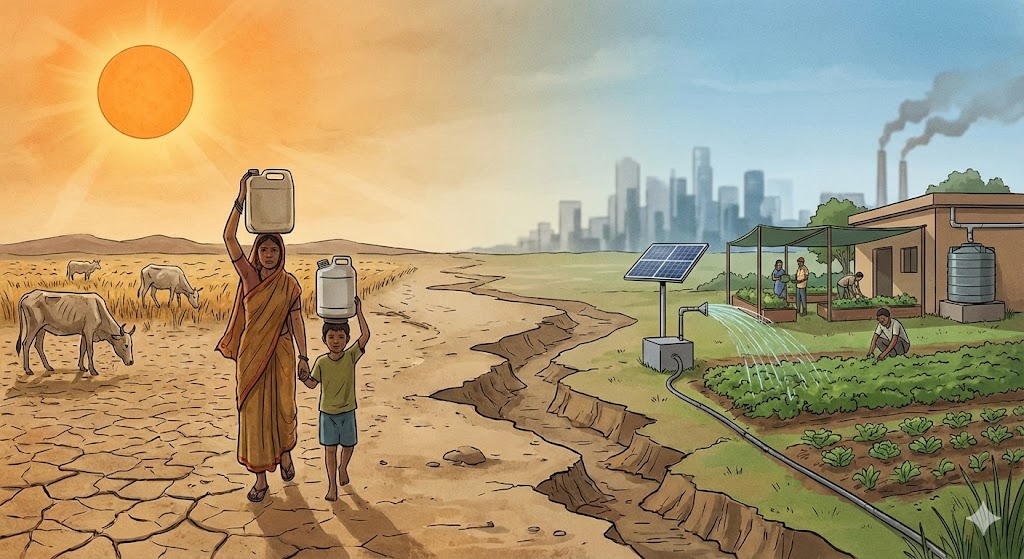
Climate change does not affect everyone equally. Across Africa, communities that have contributed least to global greenhouse gas emissions are bearing the highest costs through lost livelihoods, food insecurity, ill health, and displacement. These impacts are shaped not only by exposure to climate hazards, but by pre-existing inequalities related to poverty, gender, geography, and access to services.
This blog examines who pays the price for climate change in Africa, why vulnerability is uneven, and what credible evidence shows is needed to advance equitable, people-centred climate action.
Africa’s Disproportionate Climate Burden
Africa contributes less than 4% of global greenhouse gas emissions, yet experiences some of the most severe climate impacts (United Nations Environment Programme).
According to the Intergovernmental Panel on Climate Change (IPCC), Africa is already experiencing:
- ● Increased frequency and intensity of droughts and floods
- ● Rising temperatures affecting health and labour productivity
- ● High confidence impacts on food security, water availability, and livelihoods
These impacts disproportionately affect low-income and climate-sensitive regions.
Who Pays the Highest Price and Why
1. Poor and Rural Communities
Poverty is one of the strongest predictors of climate vulnerability. The World Bank estimates that climate change could push up to 132 million people globally into extreme poverty by 2030, primarily through impacts on agriculture, food prices, and health with Sub-Saharan Africa among the most affected regions.
Rural households, which depend heavily on rain-fed agriculture, face declining yields and income volatility as rainfall becomes more unpredictable.
2. Women and Girls
Climate shocks consistently intensify gender inequality. According to UN Women, women in rural Africa shoulder a disproportionate share of unpaid labour during droughts and floods, including water collection, food provision, and caregiving.
The IPCC confirms that climate change exacerbates gendered vulnerabilities by:
- ● Increasing time burdens on women and girls
- ● Limiting girls’ school attendance during crises
- ● Reducing women’s access to land, finance, and adaptive resources
3. Children, Older Persons, and Persons with Disabilities
The World Health Organization (WHO) warns that climate change threatens decades of public health gains, particularly for:
- ● Children (undernutrition, diarrhoeal disease, heat exposure)
- ● Older persons (heat stress, chronic illness)
- ● Persons with disabilities (barriers to evacuation, information, and services)
These groups face higher mortality and morbidity risks during climate extremes.
4. Displaced and Conflict-Affected Populations
Climate change increasingly interacts with conflict and poverty to drive displacement. The United Nations High Commissioner for Refugees (UNHCR) reports that climate-related disasters are a growing contributor to forced displacement across Africa, compounding humanitarian needs in fragile settings.
Uganda: Climate Vulnerability Through an Inequality Lens
Uganda provides a clear illustration of how climate impacts intersect with inequality.
- ● The country’s economy remains heavily dependent on rain-fed agriculture, employing the majority of rural households.
- ● According to the World Bank, climate shocks in Uganda are associated with reduced agricultural productivity, rising food insecurity, and increased poverty risks, particularly among smallholder farmers.
Evidence from Uganda Bureau of Statistics (UBOS) and development partners shows that during major flooding events in Eastern Uganda (2019–2020):
- ● Floods disrupted livelihoods and damaged infrastructure
- ● Women and girls experienced increased water-fetching and caregiving burdens, reducing time for education and income-generating activities
- ● Poor households faced slower recovery due to limited access to savings, insurance, or formal social protection
These findings are consistent with regional assessments by UN Women and the IPCC, which document how climate shocks deepen gender and income inequalities even when impacts are geographically widespread.
Climate Change as an Inequality Multiplier
The IPCC describes climate change as a “threat multiplier” one that amplifies existing vulnerabilities where health systems, education access, and social protection are weak.
Without targeted action, climate impacts risk:
- ● Reversing gains in poverty reduction
- ● Increasing malnutrition and preventable disease
- ● Entrenching intergenerational inequality
What Evidence Tells Us Works
1. People-Centred Adaptation
Adaptation strategies that prioritise livelihoods, nutrition, and health not infrastructure alone deliver more equitable outcomes.
2. Adaptive Social Protection
A widely cited African success story is Ethiopia’s Productive Safety Net Programme (PSNP). According to the World Bank and FAO, PSNP provides predictable cash or food transfers to vulnerable households and scales up during droughts, helping prevent asset depletion, reduce hunger, and build community resilience.
This evidence demonstrates that well-designed social protection can reduce climate vulnerability while addressing inequality.
3. Climate-Resilient Health and Social Systems
The WHO emphasizes that climate-resilient health systems are essential for protecting vulnerable populations from heat stress, disease outbreaks, and climate-related emergencies.
4. Gender-Responsive and Inclusive Approaches
Evidence consistently shows that adaptation is more effective when women, youth, and marginalized groups participate in decision-making and programme design.
Why Equity Must Be Central to Climate Action
Climate action that ignores inequality risks reinforcing it. Investments that fail to reach the most vulnerable can widen gaps in income, health, and opportunity.
Equity-centred climate policy requires:
✔ Disaggregated data to identify who is most at risk
✔ Inclusive planning grounded in lived realities
✔ Targeted financing for least-emitting, most-vulnerable regions
✔ Strong links between climate action, development, and social protection
✔ Disaggregated data to identify who is most at risk
✔ Inclusive planning grounded in lived realities
✔ Targeted financing for least-emitting, most-vulnerable regions
✔ Strong links between climate action, development, and social protection
Institutions like ACSPR play a vital role in generating evidence that connects climate risk with social vulnerability, ensuring climate policy responds to real human needs.
The Path Forward: Innovation for Climate Justice
Reducing climate vulnerability is not only a technical challenge it is a question of justice. Addressing inequality requires innovative financing and delivery mechanisms, including adaptive social protection, anticipatory action, and people-centred climate planning that reaches the most vulnerable before disasters strike.
Ending Thought
Climate change in Africa is not an equal-opportunity crisis. The poorest, women, children, and marginalized communities are paying the highest price for a problem they did little to create.
The true measure of climate success will not be tonnes of carbon reduced but lives protected and inequalities reduced.