✍️ Authored by ACSPR Team | Population and Demographic Research
📌 Shaping Africa’s Future with Evidence, Equity, and Innovation for Impact
📌 Shaping Africa’s Future with Evidence, Equity, and Innovation for Impact
Africa’s urban future is arriving fast.
By 2050, Africa’s urban population is projected to grow to over 1.3 billion people. This means that the continent’s cities will become home to hundreds of millions more people within a generation. The question is no longer whether Africa will urbanize. It already is. The real question is whether African cities will grow in ways that expand opportunity or deepen crisis.
Urbanization can be one of Africa’s greatest development opportunities. Well-planned cities can create jobs, connect people to markets, improve access to education and healthcare, support innovation, and drive economic transformation. But when urban growth is poorly planned, it can also produce overcrowded settlements, flooding, insecure livelihoods, weak services, pollution, inequality, and social exclusion.
That is why Africa’s urban future is not simply a population story. It is a governance story.
A City of Opportunity or a City of Exclusion?
Imagine a young woman moving from a rural district to a fast-growing African city. She comes with hope: to find work, acquire skills, start a business, or support her family. But when she arrives, the city does not welcome her with opportunity. It pushes her to an informal settlement where housing is insecure, drainage is poor, transport is expensive, and access to clean water, healthcare, and decent work is limited.
Her story is not unusual.
Across Africa, millions of people move to cities because cities promise a better life. But too often, that promise is weakened by poor planning, high living costs, unsafe housing, insecure land tenure, and limited public services. The result is a difficult contradiction: cities attract people because they offer opportunity, yet many urban residents are forced to survive in conditions that limit that opportunity.
This is the heart of Africa’s urban challenge.
Urban Growth Is Not the Problem
Urbanization itself is not the enemy.
Cities can be engines of development. They concentrate people, businesses, skills, services, infrastructure, markets, and ideas. They can support industrialization, entrepreneurship, digital innovation, cultural exchange, and public service delivery. When cities are planned well, they can help countries become more productive and more connected.
But urbanization becomes a crisis when cities grow faster than planning systems, public budgets, and institutions can respond.
Many African cities are expanding without adequate spatial planning, housing, transport, drainage, waste management, sanitation, and climate-resilient infrastructure. In some cases, planning remains top-down and disconnected from the realities of the people who live and work in informal settlements, peri-urban areas, and low-income neighbourhoods. Evidence shows that many African cities lack integrated spatial strategies, while top-down master planning has contributed to several urban challenges.
The issue, therefore, is not that African cities are growing. The issue is that many are growing without the systems needed to make urban life safe, productive, inclusive, and resilient.
From the Ground: What Urban Crisis Looks Like
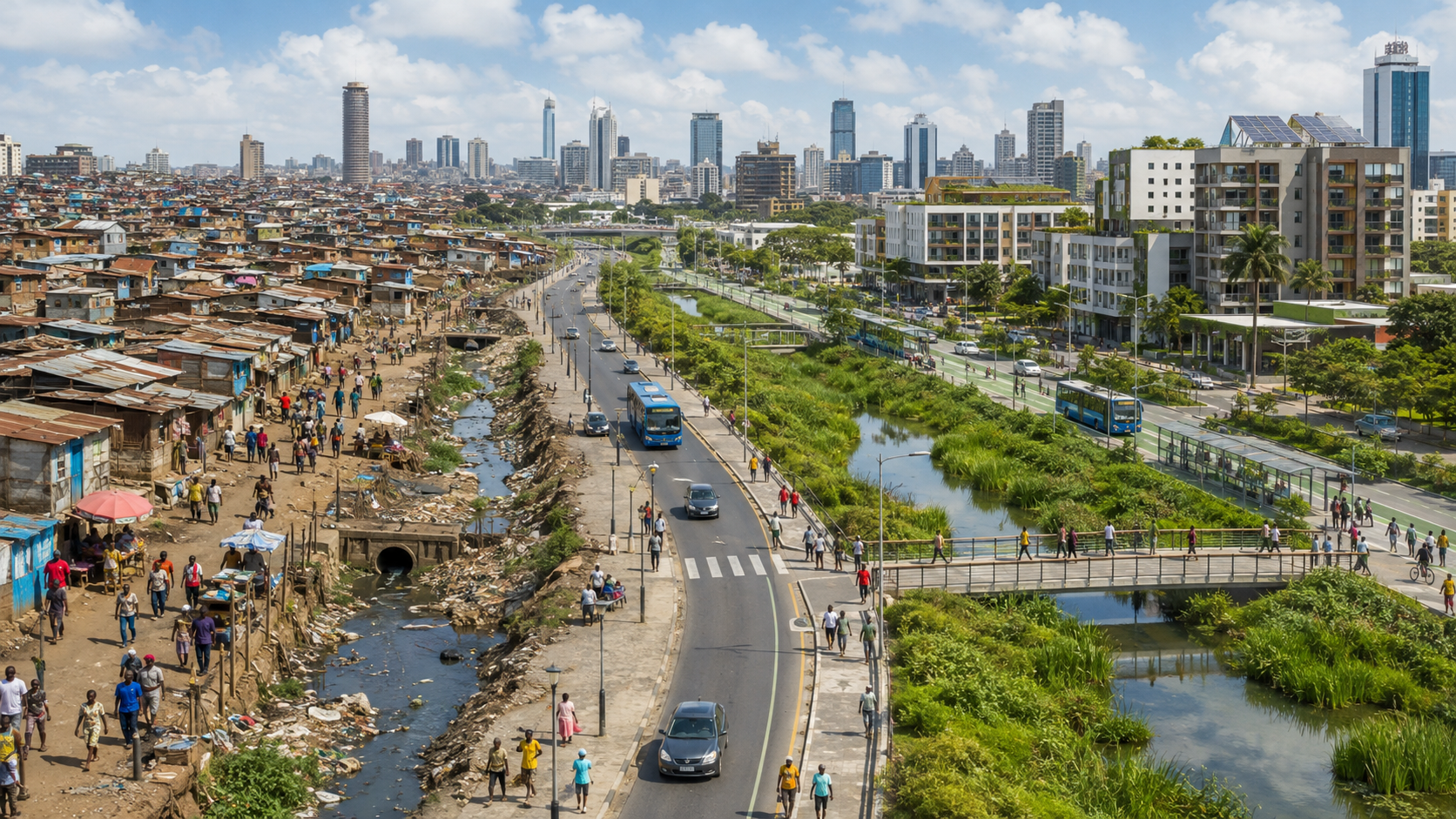
In a settlement like Kibera in Nairobi or Makoko in Lagos, urban crisis is not an abstract planning debate. It can mean waking up to flooded pathways, unsafe housing, expensive transport, insecure livelihoods, and services that do not reach the people who need them most.
For a street vendor, poor urban planning can mean losing income when markets are demolished without alternatives. For a student, it can mean walking through unsafe and flooded routes to school. For a young worker, it can mean spending hours in traffic because affordable housing is far from employment centres. For a mother, it can mean choosing between transport costs, food, and healthcare.
These realities show why inclusive urban planning matters. A city is not only built through roads, buildings, and master plans. It is built through the daily lives of the people who depend on it.
The Informality Reality
Informality is one of the defining features of African urbanization.
For many residents, informality is not a choice. It is a survival strategy. People live in informal settlements because formal housing is unaffordable. They work in informal trade because formal employment is limited. They use informal transport because public transport systems are inadequate. They rely on informal networks because formal systems often fail to reach them.
Yet planning systems often treat informality as a problem to be removed rather than a reality to be understood.
This approach can deepen exclusion. Forced evictions, unrealistic formalization programmes, rigid zoning, and planning that ignores livelihoods can harm the very people cities should support. Evidence from African cities shows that informality is poverty-driven and often unplanned, but it also supports livelihoods and economic survival for many residents.
A more realistic approach is needed. African cities must recognize informal settlements, informal workers, and informal systems as part of the urban economy. The goal should not be to erase informality overnight, but to improve safety, services, infrastructure, tenure security, and economic opportunity.
Climate Change Is Making Urban Poverty More Dangerous
Africa’s urbanization is unfolding in a climate-stressed world.
African cities are among the most climate-vulnerable and least-prepared globally. Rising temperatures, erratic rainfall, sea level rise, floods, droughts, and climate-related disasters are already affecting urban life. These risks fall hardest on poor urban populations, especially those living in informal settlements with weak housing, poor drainage, limited services, and insecure livelihoods.
For the urban poor, climate change is not abstract. It can mean a flooded home, contaminated water, destroyed goods, lost income, damaged roads, interrupted schooling, disease outbreaks, food insecurity, and mental stress.
This is why climate resilience must be central to urban planning.
Drainage systems, green infrastructure, flood-risk mapping, early warning systems, safe housing, waste management, water security, and climate-resilient transport are not luxuries. They are basic requirements for cities that want to protect lives and livelihoods.
Africa contributes less than 5% of global greenhouse gas emissions, yet many of its cities face severe climate consequences. This makes urban climate justice a major development concern.
Cities Showing What Is Possible
Not all urban growth has to become crisis. Across Africa, some cities are experimenting with approaches that offer useful lessons.
Kigali, Rwanda shows how informal settlement upgrading can be linked to infrastructure, basic services, community participation, and more inclusive urban development. The Kigali Informal Settlement Upgrading Project focuses on improving access to basic infrastructure and social services in selected neighbourhoods, while also supporting citizen participation and co-design in urban upgrading.
Freetown, Sierra Leone shows the value of nature-based urban resilience. Through the Freetown the Treetown initiative, the city is using community stewardship, digital tools, and urban reforestation to restore tree cover and build a more resilient city.
Dakar, Senegal shows how investment in mass public transport can help cities respond to mobility, congestion, and urban growth. The Dakar Bus Rapid Transit system was officially inaugurated in January 2024, marking a major step in modernizing urban transport in the city.
These examples are not perfect models to copy and paste. But they show that African cities are not only sites of crisis. They are also sites of innovation, experimentation, and learning.
The Urban Poor Must Not Be Planned Out of the City
One of the biggest risks in African urban development is planning that excludes the poor.
Too often, city planning focuses on modern skylines, highways, business districts, and smart-city ambitions while neglecting informal settlements, street vendors, low-income workers, migrants, persons with disabilities, women, and young people.
But a city cannot be called successful if large sections of its population remain excluded from decent housing, sanitation, transport, safety, public space, and economic opportunity.
The urban poor are not obstacles to development. They are workers, consumers, entrepreneurs, caregivers, voters, innovators, and citizens. They build cities, service cities, feed cities, transport cities, and sustain urban economies.
Urban planning must therefore ask: who benefits, who is displaced, who is consulted, and who is left behind?
Research emphasizes that the intersecting challenges of urbanization, inequality, climate risk, and economic sustainability require governance systems that explicitly include the urban poor.
Smart Cities Must Be Inclusive Cities
Across Africa, the language of “smart cities” is becoming more common. Digital platforms, sensors, data systems, e-governance, surveillance technologies, and automated services are increasingly promoted as solutions to urban problems.
These tools can be useful. Data can improve traffic management, service delivery, land administration, disaster response, public safety, and planning.
But smart-city approaches can also deepen inequality if they are not designed for local realities. If digital systems require internet access that many residents do not have, identification documents they cannot obtain, or platforms they cannot use, then smart-city reforms may exclude the very people who need services most.
A smart city is not truly smart if it is inaccessible to the poor.
A smart city is not truly smart if it ignores informal workers.
A smart city is not truly smart if it uses technology to make exclusion more efficient.
Evidence warns that smart-city interventions in Africa can deepen existing inequalities and amplify spatial exclusion when they are not context-sensitive.
The future of African cities should therefore be both digital and inclusive.
Nature-Based Solutions Can Help Cities Live With Water and Heat
African cities need more than concrete.
Nature-based solutions such as wetlands, urban forests, green corridors, rain gardens, permeable surfaces, river buffers, and restored ecosystems can help reduce flooding, heat stress, pollution, and biodiversity loss. They can also improve public spaces and quality of life.
Yet implementation remains limited. Evidence shows that only 15 African countries, about 27.7%, have implemented nature-based solutions, with rural areas receiving more attention than cities.
This is a missed opportunity.
As cities expand, protecting wetlands, drainage corridors, urban green spaces, and water catchment areas should be treated as core infrastructure. A wetland that absorbs stormwater is not empty land. A tree that reduces heat is not decorative. A green space that supports recreation, drainage, and cooling is not a luxury.
Climate-resilient urban planning must combine grey infrastructure with green infrastructure.
Governance Is the Difference Between Growth and Crisis
Urbanization is not only about buildings, roads, and population numbers. It is about governance.
Good urban governance determines whether cities can plan ahead, mobilize resources, coordinate agencies, enforce standards, manage land, provide services, protect vulnerable groups, and respond to climate risks.
Yet many local governments lack adequate authority, financing, technical capacity, and data systems. Decentralization has often failed to give real power and resources to local urban authorities. At the same time, governance systems are often not equipped to deliver planning at the scale required by rapid urban growth.
This creates a dangerous gap: cities are growing, but institutions are not growing fast enough to manage them.
Closing this gap requires stronger local governments, better financing, participatory planning, reliable urban data, accountable leadership, and coordination between national and city-level institutions.
Urbanization without governance becomes crisis. Urbanization with governance becomes opportunity.
What This Means
For national governments: Urbanization must be placed at the centre of national development planning. Governments should invest in housing, transport, sanitation, drainage, health, education, urban jobs, climate resilience, and local government capacity.
For city authorities: Planning should be inclusive, data-driven, and responsive to the lived realities of residents. Cities must engage informal settlement communities, women, youth, migrants, persons with disabilities, and informal workers in shaping urban priorities.
For development partners: Support should go beyond high-profile infrastructure. Investments should strengthen local governance, climate adaptation, community upgrading, urban data systems, green infrastructure, and pro-poor service delivery.
For researchers: There is a need for more evidence on informal urbanism, urban poverty, climate vulnerability, migration, land governance, service delivery, and what works in building inclusive African cities.
For civil society: Advocacy should focus on the right to the city: secure housing, accessible services, public participation, climate justice, safe environments, and accountability in urban development.
For communities: Residents are not passive beneficiaries. Community organizations, informal workers, youth groups, women’s groups, and local leaders should be supported as partners in planning, monitoring, and improving urban life.
Key Takeaways
● Africa’s urban population is growing rapidly, with projections pointing to more than 1.3 billion urban residents by 2050.
● Urbanization can drive development, but only when cities are planned, financed, and governed well.
● Informality is central to African urban life and must be understood, not simply criminalized or erased.
● Climate change is making urban poverty more dangerous, especially for residents of informal settlements.
● Smart cities must also be inclusive cities, or digital transformation may deepen exclusion.
● Nature-based solutions are essential for flood control, heat reduction, and urban resilience.
● Good urban governance is the difference between urban growth becoming opportunity or crisis.
● African cities already offer lessons, from Kigali’s upgrading efforts, to Freetown’s urban greening, to Dakar’s mass transport reforms.
The Way Forward
Africa’s urban future is not predetermined.
The continent can urbanize in ways that create jobs, expand services, strengthen innovation, reduce poverty, and build climate resilience. But this will require a different approach to planning one that is inclusive, pro-poor, climate-aware, and grounded in the realities of African cities.
Urbanization should not mean pushing the poor to the margins. It should mean building cities where all residents can live safely, work productively, move affordably, access services, and participate in decisions that shape their future.
The real measure of urban success will not be the height of buildings or the width of highways. It will be whether cities improve the lives of the people who live in them.
Africa’s urban future can be a crisis.
But with the right planning, governance, and investment, it can also be one of the continent’s greatest opportunities.
References
Ansah, E. W., Amoadu, M., Obeng, P., & Sarfo, J. (2024). Climate change, urban vulnerabilities and adaptation in Africa: A scoping review. Climatic Change, 177. https://doi.org/10.1007/s10584-024-03711-8
Bandauko, E., & Arku, R. N. (2022). A critical analysis of ‘smart cities’ as an urban development strategy in Africa. International Planning Studies, 28, 69–86. https://doi.org/10.1080/13563475.2022.2137112
Cobbinah, P. B. (2020). Urban resilience in climate change hotspot. Land Use Policy, 100, 104948. https://doi.org/10.1016/j.landusepol.2020.104948
Cobbinah, P. B. (2023). City in Africa I: Urbanism and informality. Journal of Urban Affairs, 45, 297–301. https://doi.org/10.1080/07352166.2023.2171616
Cobbinah, P. B., & Finn, B. (2022). Planning and climate change in African cities: Informal urbanization and ‘just’ urban transformations. Journal of Planning Literature, 38, 361–379. https://doi.org/10.1177/08854122221128762
Finn, B., & Cobbinah, P. B. (2022). African urbanisation at the confluence of informality and climate change. Urban Studies, 60, 405–424. https://doi.org/10.1177/00420980221098946
Kamana, A., Radoine, H., & Nyasulu, C. (2023). Urban challenges and strategies in African cities: A systematic literature review. City and Environment Interactions. https://doi.org/10.1016/j.cacint.2023.100132
Kiribou, R., Djene, S. W., Bedadi, B., Ntirenganya, E., Ndemere, J., & Dimobe, K. (2024). Urban climate resilience in Africa: A review of nature-based solution in African cities’ adaptation plans. Discover Sustainability, 5. https://doi.org/10.1007/s43621-024-00275-6
Lemaire, X. (2021). Climate change and strategic low-carbon planning in African cities after COVID-19: Inclusiveness or chaos? Journal of the British Academy. https://doi.org/10.5871/jba/009s9.039
Meyer, N., & Auriacombe, C. (2019). Good urban governance and city resilience: An Afrocentric approach to sustainable development. Sustainability. https://doi.org/10.3390/su11195514
Møller-Jensen, L., Agergaard, J., Andreasen, M. H., Kofie, R., Yiran, G., & Oteng‐Ababio, M. (2022). Probing political paradox: Urban expansion, floods risk vulnerability and social justice in urban Africa. Journal of Urban Affairs, 45, 505–521. https://doi.org/10.1080/07352166.2022.2108436
Ndebele-Murisa, M., Mubaya, C., Pretorius, L., Mamombe, R., Iipinge, K., Nchito, W., Mfune, J., Siame, G., & Mwalukanga, B. (2020). City to city learning and knowledge exchange for climate resilience in southern Africa. PLOS ONE, 15. https://doi.org/10.1371/journal.pone.0227915
Tietjen, B., Jacobsen, K., & Hollander, J. B. (2023). Climate change and urban migration in Sub-Saharan African cities: Impacts and governance challenges. Journal of Climate Resilience and Climate Justice, 1, 20–32. https://doi.org/10.1162/crcj_a_00009
Wijesinghe, A., & Thorn, J. (2021). Governance of urban green infrastructure in informal settlements of Windhoek, Namibia. Sustainability. https://doi.org/10.3390/su13168937
Ziervogel, G. (2019). Building transformative capacity for adaptation planning and implementation that works for the urban poor: Insights from South Africa. Ambio, 48, 494–506. https://doi.org/10.1007/s13280-018-1141-9